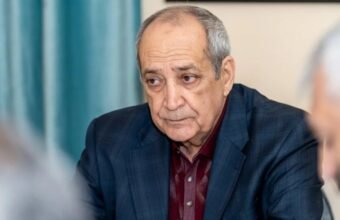

























News.Az spoke with Archil Sikharulidze, founder of the SIKHA Foundation, a Tbilisi-based research institute focusing on political and social studies, about the visit, regional diplomacy, and the future of the Middle Corridor.
– How do you assess the results of Armenian Prime Minister Nikol Pashinyan’s visit to Georgia and the outcomes of the 15th meeting of the Intergovernmental Commission on Economic Cooperation between Armenia and Georgia?
– The meeting between Armenian Prime Minister Nikol Pashinyan and his Georgian counterpart Irakli Kobakhidze was quite lengthy. Both sides expressed a desire to further deepen relations between the two countries. However, to be honest, it is not entirely clear what the main objective of the meeting was. There had been discussions that certain documents might be signed, but so far no information about this has emerged.
Source: Armenpress.am
It can be assumed that the meeting was significant primarily because Nikol Pashinyan used it to promote himself politically. As part of his public relations efforts, he sought to demonstrate that he enjoys support from Tbilisi.
Meanwhile, the ruling Georgian Dream party, which many opponents accuse of isolating the country, attempted to show the opposite — that it remains active and ready to cooperate with regional countries, especially Armenia, which is very important for Georgia.
However, it is still too early to speak about any major breakthroughs.
– Georgian officials have repeatedly stated that they are ready for dialogue with the West. In your opinion, is Tbilisi using Yerevan’s opportunities to mediate with the West?
– Yes, certainly. Georgian Dream is trying to use Armenia and Azerbaijan as channels to reach out to the administration of U.S. President Donald Trump, since the previous administration of Joe Biden cut off nearly all ties with Tbilisi in the hope of seeing a change of government.
However, instead of Georgian Dream going on a long vacation, Joe Biden himself lost power. Now Tbilisi is trying, through the same Middle Corridor — the so-called Trump route — and through its connections with Baku and Yerevan, to establish contact with the Trump administration. Whether this will succeed remains to be seen. For now, there are still no reliable sources confirming this.
– How do you assess Georgia’s potential to become a logistics and energy hub within the corridor between the South Caucasus and Central Asia?
– Georgia is very confident about this issue. The latest conclusions and reports by the European Union and the European Commission regarding Georgia indicate that the country will not lose its transit role, even if all new logistics projects are implemented.
Source: TASS
Even if all possible transport links between Armenia, Azerbaijan and Türkiye are opened, Georgia will still remain, in one form or another, a zone of stability. It is a country that has fulfilled its obligations consistently for 30 years. Georgia is also considered a key country for transporting various goods and energy resources from Central Asia to Türkiye and then onward to Europe.
– In your opinion, what challenges may arise in implementing projects aimed at developing the Middle Corridor, and how can they be overcome?
– In my opinion, the main challenge at the moment is the military escalation around Iran. If hostilities continue and lead to large-scale shocks, the main danger will be a large influx of refugees into Azerbaijan, Armenia, and Georgia.
If a humanitarian crisis occurs, it will be very difficult for our countries to cope with it. It will be even more difficult to invest in projects that require significant political and economic attention. Therefore, the main threat to any logistics project at the moment is the military escalation involving Iran.