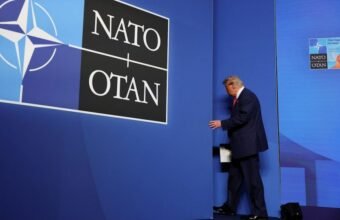



























His remarks come at a time of heightened geopolitical tension, particularly linked to developments involving Iran.
***
Growing tensions within NATO
At the core of the dispute is Washington’s frustration with European allies, whom Trump accuses of failing to contribute sufficiently to efforts aimed at safeguarding maritime routes in the Gulf region. The Strait of Hormuz remains one of the world’s most critical chokepoints for global energy supplies, and disruptions there carry significant economic and strategic implications.
What the U.S. Constitution says
From a constitutional perspective, the issue of treaty withdrawal remains ambiguous. While the U.S. Constitution clearly outlines the process for entering treaties – requiring approval from two-thirds of the Senate – it does not explicitly define how a president may exit such agreements. This legal grey area has long been debated among scholars and policymakers.
NATO treaty provisions
The NATO framework itself provides a formal withdrawal mechanism. Article 13 of the North Atlantic Treaty allows any member state to leave the alliance after giving one year’s notice. Notably, since NATO’s founding in 1949, no member has ever invoked this provision, underscoring the alliance’s historical stability.
U.S. law and congressional limits
Domestic U.S. legislation has sought to limit unilateral executive action. In 2023, Congress passed a law – signed by then-President Joe Biden – requiring Senate approval for any withdrawal from NATO. The measure, introduced by lawmakers including Tim Kaine and Marco Rubio, also prohibits the use of federal funds for such a move without legislative backing.
Conflicting legal interpretations
Despite this, legal interpretations remain contested. A prior opinion from the U.S. Department of Justice during Trump’s first presidency argued that treaty withdrawal authority resides exclusively with the executive branch. More recent analyses suggest that any attempt to withdraw could trigger a constitutional confrontation between the White House and Congress.
Political signals from Washington
Trump’s rhetoric has further fueled uncertainty. He has indicated that he is “absolutely” considering withdrawal, framing his stance as a response to what he describes as insufficient burden-sharing by European allies. His position has been echoed to some extent by Defense Secretary Pete Hegseth, who has refrained from firmly reaffirming U.S. commitments to NATO’s collective defense principle.
Experts such as Max Bergmann argue that beyond legal constraints, political will is decisive. Even without formal withdrawal, a reduced U.S. commitment could weaken NATO’s effectiveness and alter the strategic balance in Europe and beyond.
What happens next
Looking ahead, any attempt by the United States to exit NATO would likely face significant legal and political challenges. Courts could be called upon to interpret the balance of powers between Congress and the presidency, though such cases are historically rare and complex.
At the international level, treaty withdrawal is generally permissible if conducted in accordance with established procedures. The United States has previously exited agreements, including the Open Skies Treaty, without explicit congressional approval, setting precedents that could influence future decisions.
Ultimately, while a formal withdrawal would mark a historic shift in global security architecture, even raising the possibility signals growing strain within one of the world’s most enduring military alliances.