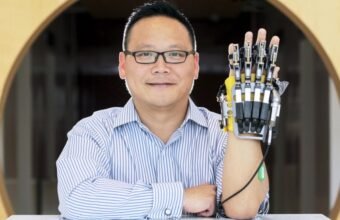



























Doctors at the First Affiliated Hospital of Guangxi Medical University said the treatment combined a brain computer interface, spinal cord stimulation and a robotic exoskeleton in what they described as a regional first, News.az reports, citing Xinhua.
***
The patient, a 48 year old man identified only by his surname, Li, had been left paralysed on the left side of his body after suffering a major stroke in late 2024.
During a rehabilitation session in March, Li wore a cap fitted with electrodes and stood inside a robotic exoskeleton. After focusing on the thought that he wanted to walk, the system interpreted his intention and triggered movement in the device.
Doctors said the process allowed him to take a step under his own volition for the first time since the stroke.
According to the medical team, the system works as a closed loop. The brain computer interface detects the patient’s intention to move, while spinal cord stimulation helps reduce muscle spasms and reactivate damaged neural pathways. The exoskeleton then carries out the movement and feeds the sensation back to the brain.
Neurosurgery chief Feng Daqin said the approach was designed to make the patient an active participant in rehabilitation rather than a passive recipient of treatment.
In conventional stroke therapy, patients with severe paralysis often rely on repeated external manipulation of their limbs through methods such as massage or acupuncture. Doctors said Li had shown only limited improvement after months of standard rehabilitation.
After two weeks of intensive training with the new system, he was able to voluntarily raise his arm and bend his knee, according to the hospital.
Mr Feng said brain computer interface technology itself was not entirely new, pointing to devices such as cochlear implants as earlier examples. But he said newer systems were moving beyond single function devices towards more complex interaction between brain signals, electrical stimulation and assisted movement.
He added that while non invasive caps may be less precise than implanted devices, they offer greater safety and were sufficient for Li’s clinical needs.
The treatment comes as China increases efforts to bring brain computer interface technology into broader medical use, particularly for stroke and spinal injury patients.
Chinese medical institutions expanded related clinics and specialist wards in 2025, a year seen by many in the sector as a turning point for the technology’s clinical rollout.
That same year, national authorities issued pricing guidance for neural system care services, formally listing brain computer interfaces as an independent category in a move aimed at supporting wider clinical use.
This year, regulators also approved an implantable brain computer interface device for patients with paralysis caused by cervical spinal cord injuries. Developed by a Shanghai company and Tsinghua University, it has been described as the world’s first commercially approved invasive brain computer interface product.
China has placed particular emphasis on stroke rehabilitation because of the scale of the challenge. The country is home to an estimated 26.7 million stroke patients, creating one of the world’s heaviest disease burdens in this area.
Mr Feng said the demand for stroke treatment was far greater than that for spinal cord injuries alone.
He also said China’s approach differs in some respects from research in many Western countries, where invasive brain implants requiring open surgery have attracted greater attention. Chinese hospitals, he said, have often prioritised non invasive or minimally invasive methods in an effort to improve safety and accessibility.
While major centres in cities such as Beijing continue to pursue advanced implant research, regional hospitals are also developing their own hybrid models.
The Guangxi team is now exploring whether similar technology could be used to treat other neurological disorders, including Parkinson’s disease.
Doctors at the hospital also believe the system could have wider significance beyond China. Guangxi borders South East Asia and is seen as a gateway to ASEAN markets, raising the possibility of future regional medical cooperation.
For Li, however, the immediate meaning is simpler.
He still uses a wheelchair between training sessions. But each day, doctors say, he returns to the gym, focuses his mind and takes another step.
For someone who once feared he might never walk again, that movement has become a sign of recovery and hope.