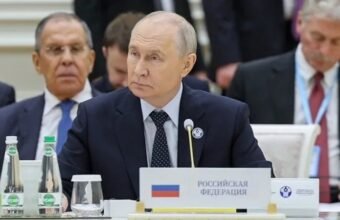













The three-day election, which began Friday, will determine all 450 seats in Russia’s State Duma. The governing United Russia party, which backs President Vladimir Putin, is expected to retain its dominant position, Al Jazeera reported.
The election has also highlighted divisions among Russian voters over the war, with some viewing the ballot as an opportunity to express dissatisfaction and others emphasizing national unity and support for the military.
***
President Putin has linked the election to the war effort, urging voters to demonstrate support for Russian soldiers and national unity. State television election advertising has similarly used patriotic and military imagery.
Among the candidates is Damir Gurin of the Green Party, who is campaigning in Russia’s Far Eastern Federal District on issues including affordable housing, industrial emissions and recycling.
“My goal is to provide this harsh land and its people with worthy ecological and institutional representation,” Gurin told Al Jazeera.
For some voters, however, the war has overshadowed domestic issues.
Aleksey, a resident of St. Petersburg who spoke to Al Jazeera without giving his full name, described the election as a “sham” and said his mother has experienced the effects of drone attacks near her home outside the city.
Other Russians interviewed by Al Jazeera expressed different views. One voter said he was considering supporting the Communist Party while acknowledging that “no party can be against war” under the current circumstances.
Polling cited by Reuters indicates that more than 60% of Russians support peace negotiations, while support for the Russian military operation remains high. The war has also increasingly affected daily life through drone attacks, fuel shortages and internet disruptions.
The liberal Yabloko party, Russia’s only registered political party to openly oppose the war, was removed from the federal party-list ballot in August following a Supreme Court ruling. The case was brought by the nationalist Rodina party, which accused Yabloko of violating electoral rules and receiving foreign support. Yabloko rejected the allegations.
Individual Yabloko candidates are still allowed to contest some single-mandate constituencies. In Moscow, Yabloko candidate Polina Lermant has campaigned on a “vote for peace” message. Reuters has described her as one of the few openly antiwar candidates still contesting a parliamentary seat.
Other parties on the ballot include the Communist Party, the Liberal Democratic Party, A Just Russia, New People, the Green Party, the Party of Pensioners, Communists of Russia, the Party of Direct Democracy and Rodina. Several of these parties support the government’s position on the war, while others have focused their campaigns on domestic and economic issues.
The election is being held from Sept. 18 to 20, with voters also participating in regional and local contests. Voting is taking place in Russian-controlled areas of Ukraine, a process that has drawn additional scrutiny.
The result will determine the composition of the 450-seat State Duma and provide a measure of voting patterns and public sentiment during the ongoing war, although the extent to which the election reflects the full range of political views in Russia remains contested.