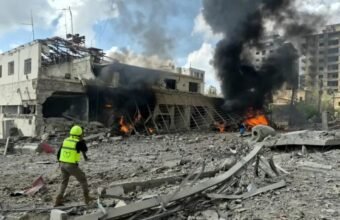



























From short range battlefield rockets to medium and long range ballistic missiles capable of striking targets more than 1,500 miles away, Iran’s missile forces form the backbone of its deterrence strategy, News.az reports.
***
Iran’s missile program has steadily evolved since the 1980s, driven by war experience, international isolation, sanctions, and a strategic doctrine that prioritizes self reliance. Today, estimates suggest Iran possesses missiles with ranges from approximately 186 miles to between 1,553 miles and in some cases around 2,000 kilometers. These systems include ballistic missiles, cruise missiles, anti ship missiles, and newer maneuverable and high speed designs.
WHY DID IRAN DEVELOP A MISSILE PROGRAM?
Iran’s missile development accelerated during the Iran Iraq war in the 1980s. During that conflict, Iraqi missile strikes on Iranian cities exposed Tehran’s vulnerability and its lack of modern air power. International sanctions and limited access to advanced aircraft meant Iran could not rely on conventional air superiority for deterrence. Missiles became a strategic equalizer. They required less dependence on foreign suppliers and provided a means to deter adversaries without a large modern air force. Over time, missile development became central to Iran’s national defense doctrine. Iran’s leadership consistently frames its missile program as defensive. Officials argue that in a region with advanced air forces, foreign military bases, and missile defense systems, long range strike capability is necessary to deter attacks.
WHAT TYPES OF MISSILES DOES IRAN HAVE?
Iran’s missile inventory can be divided into three primary categories: ballistic missiles, cruise missiles, and anti ship missiles. There are also emerging advanced systems including maneuverable re entry vehicles and high speed glide vehicles.
WHAT ARE BALLISTIC MISSILES AND WHICH ONES DOES IRAN OPERATE?
Ballistic missiles are rocket powered systems that follow a high arc trajectory before descending onto their targets. They travel at very high speeds, especially during re entry. Iran operates several classes. Short range ballistic missiles generally have ranges up to 300 kilometers or roughly 186 miles. These are designed for battlefield and regional targets. Examples include early Shahab variants and solid fuel systems like Zolfaghar. Medium range ballistic missiles extend from roughly 300 kilometers to 1,500 kilometers. These include systems such as Shahab 3, Emad, and Ghadr. These missiles can reach targets across the Middle East. Longer range ballistic missiles such as Sejil and Khorramshahr variants are reported to approach 2,000 kilometers or slightly more. These systems are capable of striking targets across much of the Middle East and parts of southeastern Europe. Iran has publicly stated that it limits its missile range to around 2,000 kilometers. That range is sufficient to cover regional adversaries but does not reach Western Europe or North America.
WHAT IS THE DIFFERENCE BETWEEN LIQUID FUEL AND SOLID FUEL MISSILES?
Earlier Iranian ballistic missiles used liquid fuel. These systems require fueling before launch, making them slower to deploy and more vulnerable to detection. More recent Iranian systems use solid fuel. Solid fuel missiles can be stored fueled and launched more quickly. They are easier to transport and deploy, increasing survivability. The transition to solid fuel represents a significant technological improvement in Iran’s missile program.
WHAT ABOUT CRUISE MISSILES?
Cruise missiles differ from ballistic missiles because they are guided throughout their flight and typically fly at low altitudes. They use jet engines rather than rocket propulsion during most of their flight. Iran has developed several land attack cruise missiles such as Soumar and Hoveyzeh. Reported ranges vary but are often estimated between 1,000 and 1,350 kilometers. Cruise missiles can be more difficult to detect because they fly close to terrain. Their guidance systems allow greater precision compared to older ballistic missiles.
DOES IRAN HAVE ANTI SHIP MISSILES?
Yes. Iran has invested heavily in anti ship cruise missiles. These systems are designed to target naval vessels in the Persian Gulf and surrounding waters. Missiles such as Noor, Qader, and Nasr variants are reported to have ranges between 200 and 300 kilometers. These systems play a central role in Iran’s maritime deterrence strategy. Given the narrow geography of the Strait of Hormuz, anti ship missiles are considered a critical component of Iran’s asymmetric defense planning.
HOW FAR CAN IRAN’S MISSILES REACH?
Estimates suggest Iran’s missile ranges begin around 186 miles and extend up to approximately 1,553 miles. Some solid fuel systems are reported to approach 2,000 kilometers, which equals about 1,240 miles. From central Iran, a 2,000 kilometer range covers Israel, Saudi Arabia, United Arab Emirates, Qatar, Bahrain, Kuwait, Turkey, and large portions of the eastern Mediterranean. The stated range limitation appears designed to focus on regional deterrence rather than intercontinental capability.
DOES IRAN HAVE INTERCONTINENTAL BALLISTIC MISSILES?
There is no confirmed evidence that Iran possesses operational intercontinental ballistic missiles capable of exceeding 5,500 kilometers. Developing such systems would require significant advances in propulsion, guidance, and re entry vehicle design. While Iran has conducted space launch vehicle tests that use similar technologies, an operational ICBM program has not been confirmed.
HOW ACCURATE ARE IRAN’S MISSILES?
Accuracy varies widely depending on the missile type and generation. Older ballistic missiles may have circular error probabilities measured in hundreds of meters or more. That level of accuracy is sufficient for large military targets but less suitable for pinpoint strikes. Newer systems such as Emad reportedly incorporate improved guidance, including maneuverable re entry vehicles that allow adjustments during descent. Cruise missiles generally offer higher precision because they are continuously guided throughout flight. Iran has also showcased missiles with claimed precision strike capability. Independent verification of exact accuracy levels remains difficult.
WHAT ROLE DO MISSILES PLAY IN IRAN’S MILITARY DOCTRINE?
Missiles are central to Iran’s deterrence strategy. Without a large modern air force, Iran relies on missiles to offset adversaries’ technological advantages. The doctrine emphasizes survivability, mobility, and dispersal. Many missile launchers are road mobile and can be hidden in hardened underground facilities. The concept is often described as layered deterrence. Iran combines missiles with drones, naval forces, proxy groups, and air defense systems to complicate an adversary’s planning.
HAS IRAN USED MISSILES IN COMBAT?
Iran has launched ballistic missiles in several regional incidents over the past decade. These have included strikes against militant targets in neighboring countries and retaliatory attacks in response to security incidents. More recently, missile exchanges between Iran and regional adversaries have demonstrated both capability and interception challenges. Combat use provides operational data, allowing adjustments in tactics and technology.
WHAT ABOUT HYPERSONIC MISSILES?
Iran has unveiled what it describes as hypersonic missile systems. Hypersonic weapons travel at speeds greater than Mach 5 and may include maneuverable glide vehicles. If fully operational, such systems could reduce reaction times and complicate missile defense interception. However, independent assessments of operational readiness remain limited. Public demonstrations often provide few technical details.
HOW MANY MISSILES DOES IRAN HAVE?
Precise inventory numbers are not publicly confirmed. Analysts widely assess that Iran possesses hundreds to potentially thousands of short and medium range missiles. Production capability appears ongoing, with domestic manufacturing facilities supporting sustained output despite sanctions.
ARE IRAN’S MISSILES NUCLEAR CAPABLE?
Ballistic missiles by design can carry various payloads. Iran officially denies pursuing nuclear weapons. International concern arises because long range ballistic missiles are historically associated with nuclear delivery systems. The debate over missile capabilities often intersects with discussions about nuclear restrictions and international agreements.
HOW DO MISSILE DEFENSE SYSTEMS COUNTER IRANIAN MISSILES?
Countries in the region have invested heavily in missile defense systems. These include radar networks, interceptor missiles, and layered defense architecture. Ballistic missiles travel extremely fast during re entry, making interception complex but possible with advanced systems. Cruise missiles present different challenges because they fly low and may approach from unexpected directions. No missile defense system offers complete protection. Interception rates depend on detection time, trajectory, and the number of incoming missiles.
HOW HAVE SANCTIONS AFFECTED IRAN’S MISSILE DEVELOPMENT?
Sanctions have restricted access to foreign components and advanced electronics. Nevertheless, Iran has built a largely domestic production base. Isolation may have slowed certain technological advances, but it also encouraged local innovation and reverse engineering. Missile development has remained a high national priority, ensuring continued investment despite economic pressure.
WHAT IS THE STRATEGIC SIGNIFICANCE OF IRAN’S 2,000 KILOMETER LIMIT?
Iranian officials have repeatedly stated that their missiles will not exceed 2,000 kilometers in range. This limit appears calibrated to cover regional adversaries without provoking direct intercontinental escalation. The range envelope reflects a strategic calculation, sufficient reach for regional deterrence while avoiding the technical and political consequences of developing intercontinental systems.
HOW DO IRAN’S MISSILES COMPARE REGIONALLY?
Iran’s missile force is widely regarded as one of the largest in the Middle East. While some regional states possess advanced air forces and missile defense systems, Iran compensates with quantity, mobility, and diverse missile types. The balance creates a deterrence dynamic in which all sides invest heavily in both offensive and defensive capabilities.
WHAT FUTURE DEVELOPMENTS ARE POSSIBLE?
Potential areas of advancement include improved accuracy through advanced guidance systems, expanded use of solid fuel propulsion, enhanced maneuverable re entry vehicles, greater integration with drone and surveillance networks, and development of faster and more evasive flight profiles. Whether Iran maintains its declared range limit will depend on geopolitical developments.
CONCLUSION
Over more than three decades, Iran has developed a substantial and diversified missile arsenal with estimated ranges from approximately 186 miles to over 1,500 miles, and in some systems approaching 2,000 kilometers. These capabilities form the backbone of Iran’s deterrence doctrine. While not intercontinental in confirmed scope, they provide extensive regional reach and significant strategic weight. The evolution of solid fuel systems, cruise missiles, and potentially hypersonic technologies suggests continued modernization. At the same time, regional missile defense systems and geopolitical pressures ensure that the missile balance remains dynamic. Iran’s missile program is therefore not only a military issue but also a central element in broader diplomatic, strategic, and security debates that continue to shape the region.