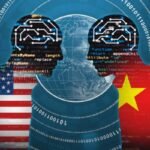






















What was once largely an economic partnership built on trade and globalization has increasingly evolved into a multidimensional rivalry involving technology, military power, global influence, supply chains, ideology and national security.
***
Many analysts now openly ask whether the world is witnessing the emergence of a new Cold War.
The comparison reflects growing fears that competition between Washington and Beijing could reshape the international system for decades, dividing global markets, technology ecosystems and geopolitical alliances into rival blocs.
At the same time, however, the relationship between the United States and China differs significantly from the original Cold War between the United States and the Soviet Union. The two economies remain deeply interconnected, global trade continues linking both countries and neither side appears willing to fully sever economic ties despite escalating tensions.
This has created a complicated global environment where competition and interdependence exist simultaneously.
The central question facing policymakers today is whether the world’s two largest powers can manage strategic rivalry without allowing it to escalate into open confrontation.
Why are U.S.–China relations deteriorating?
The deterioration of relations between Washington and Beijing did not occur suddenly.
For decades, economic cooperation dominated bilateral ties. China’s integration into the global economy accelerated after joining the World Trade Organization in 2001. American companies invested heavily in Chinese manufacturing while consumers benefited from cheaper products and expanding trade.
However, several developments gradually transformed perceptions inside the United States.
Many American policymakers began arguing that China’s rapid economic and technological rise challenged long term U.S. global leadership. Concerns increased regarding:
Trade imbalances
Intellectual property disputes
Industrial subsidies
Technology transfer
Cybersecurity
Military modernization
Human rights issues
At the same time, China increasingly viewed American policies as efforts to contain its development and limit its international influence.
The result has been growing mistrust on both sides.
Today, competition extends far beyond trade. It now affects nearly every major area of international politics.
Why do some experts compare the rivalry to the Cold War?
The term “Cold War” refers to prolonged geopolitical confrontation without direct large scale military conflict between major powers.
Several similarities between current U.S.–China tensions and the original Cold War have fueled these comparisons.
These include:
Strategic military competition
Technological rivalry
Competing global influence
Ideological tensions
Expanding alliance systems
Economic pressure tools
Information warfare
The Indo Pacific region has become particularly central to this competition, much like Europe during the original Cold War.
Military activity around Taiwan, the South China Sea and broader Asian maritime routes has intensified significantly in recent years.
At the same time, both Washington and Beijing increasingly portray the rivalry as a struggle over the future international order itself.
However, many experts caution against oversimplified comparisons.
Unlike the Soviet Union, China is deeply integrated into global trade and financial systems. The American and Chinese economies remain closely connected despite rising tensions.
This economic interdependence creates both stabilizing incentives and additional vulnerabilities.
How important is economics in the rivalry?
Economic competition lies at the center of modern U.S.–China tensions.
China has become the world’s second largest economy and a dominant manufacturing power. It plays critical roles in:
Electronics production
Rare earth minerals
Battery supply chains
Solar technology
Electric vehicles
Consumer manufacturing
Meanwhile, the United States remains dominant in:
Advanced semiconductors
Financial systems
Software
Aerospace
Global reserve currency influence
Trade relations between the two countries remain enormous despite political tensions.
However, economic policy has increasingly become tied to national security.
Washington has introduced tariffs, export controls and restrictions targeting advanced technologies, particularly semiconductors and artificial intelligence systems.
The United States argues that certain technologies could strengthen China’s military capabilities and threaten strategic balance.
China, meanwhile, accuses Washington of attempting to slow its technological development and maintain global dominance.
As a result, economic globalization itself is increasingly being reshaped by geopolitical competition.
Why are semiconductors so important?
Semiconductors have become one of the most strategically important issues in U.S.–China relations.
Modern chips power nearly every advanced technology system including:
Artificial intelligence
Smartphones
Military equipment
Data centers
Telecommunications
Electric vehicles
Aerospace systems
The United States and its allies currently dominate the most advanced semiconductor technologies, while China remains highly dependent on imported high end chips.
Washington has imposed restrictions limiting Chinese access to advanced semiconductor equipment and AI related technologies.
These measures are intended to prevent China from rapidly advancing in critical strategic sectors.
China, in response, has accelerated efforts to achieve technological self sufficiency.
The semiconductor rivalry increasingly represents a broader struggle for technological leadership in the 21st century.
What role does Taiwan play in tensions?
Taiwan is widely viewed as the most dangerous flashpoint in U.S.–China relations.
China considers Taiwan part of its territory and has repeatedly stated that reunification remains a national priority.
The United States officially follows the “One China” policy while simultaneously maintaining unofficial ties with Taiwan and supporting its defensive capabilities.
Tensions have increased significantly in recent years as:
Chinese military activity near Taiwan expanded
U.S. political and military support for Taiwan increased
Regional alliances strengthened
Indo Pacific security competition intensified
Taiwan is also critically important economically because it hosts some of the world’s most advanced semiconductor manufacturing facilities.
A major crisis in the Taiwan Strait could therefore have enormous global economic consequences.
Many analysts view Taiwan as the area where strategic competition carries the highest risk of military escalation.
How are military tensions evolving?
Military competition between the United States and China has intensified rapidly.
China has significantly modernized its armed forces over the past two decades, expanding capabilities in:
Naval power
Missile systems
Cyber warfare
Space technologies
Air defense
Artificial intelligence
The United States continues strengthening military alliances and partnerships across the Indo Pacific region, including with:
Japan
South Korea
Australia
The Philippines
India
Freedom of navigation operations in the South China Sea and military exercises near Taiwan have become increasingly common.
At the same time, both countries remain cautious about direct confrontation.
The economic and geopolitical consequences of open conflict between two nuclear powers would likely be catastrophic globally.
This creates a paradox where competition intensifies while both sides simultaneously seek to avoid uncontrolled escalation.
How does ideology influence the rivalry?
Ideological differences also shape perceptions between Washington and Beijing.
American officials frequently frame the rivalry around:
Democracy
Human rights
Open markets
International rules based systems
Chinese leaders, meanwhile, emphasize:
Sovereignty
Political stability
Economic development
Noninterference
Multipolar global governance
Beijing often argues that Western countries seek to impose political values internationally, while Washington increasingly warns about authoritarian influence and democratic backsliding globally.
However, modern U.S.–China competition is generally less ideological than the original Cold War between capitalism and communism.
Economic pragmatism and strategic interests often remain more important than ideological confrontation alone.
Can both powers decouple economically?
“Decoupling” refers to reducing economic dependence between the United States and China.
Some policymakers advocate partial decoupling in strategic sectors such as:
Semiconductors
Telecommunications
Artificial intelligence
Critical minerals
Pharmaceuticals
However, full economic separation would be extremely difficult.
The two economies remain deeply interconnected through:
Manufacturing
Supply chains
Consumer markets
Financial systems
Investment flows
Many multinational companies continue operating heavily in both countries.
As a result, some experts prefer the term “de risking” rather than complete decoupling.
This involves reducing strategic vulnerabilities while maintaining broader economic engagement.
Global businesses increasingly face pressure to diversify supply chains and reduce overreliance on either side.
How are other countries responding?
Many countries are attempting to balance relations with both Washington and Beijing simultaneously.
China remains a major trading partner for much of the world, while the United States continues playing central roles in:
Security alliances
Global finance
Technology
Military protection
As a result, many governments do not want to choose exclusively between the two powers.
This is particularly visible across:
Southeast Asia
The Middle East
Africa
Latin America
Central Asia
Several emerging economies increasingly seek multipolar diplomacy that avoids alignment with only one side.
The Global South has become especially important in this competition because both powers seek influence through:
Infrastructure investment
Trade agreements
Energy cooperation
Technology partnerships
Development financing
How does artificial intelligence affect the rivalry?
Artificial intelligence has become one of the most important strategic battlegrounds between the two countries.
AI is expected to influence:
Economic productivity
Military systems
Cybersecurity
Surveillance technologies
Scientific research
Digital infrastructure
Both Washington and Beijing view AI leadership as critical for future global influence.
This competition has accelerated investment in:
Data centers
Semiconductor development
Research funding
Advanced computing
Quantum technologies
AI competition also raises concerns regarding military escalation and cyber conflict.
Autonomous weapons systems, AI driven intelligence analysis and digital surveillance capabilities are becoming increasingly important in national security strategies.
Could cooperation still be possible?
Despite intense rivalry, the United States and China continue cooperating in certain areas.
Climate change represents one major example because both countries are among the world’s largest carbon emitters.
Global economic stability also requires some level of coordination between the two largest economies.
Other areas where cooperation remains possible include:
Public health
Financial stability
Nuclear nonproliferation
Counterterrorism
Climate policy
Diplomatic communication channels therefore remain critically important.
Many analysts argue that strategic competition does not automatically make conflict inevitable.
The challenge is establishing mechanisms that prevent rivalry from escalating uncontrollably.
What makes this rivalry different from the original Cold War?
Several major differences distinguish modern U.S.–China competition from the Soviet American Cold War.
First, economic interdependence remains far greater.
Second, globalization creates more complex international relationships where countries often maintain ties with both powers simultaneously.
Third, technology and digital infrastructure now play central roles alongside traditional military competition.
Finally, global challenges such as climate change and pandemics require at least some degree of international cooperation regardless of geopolitical rivalry.
This creates a more interconnected but also more unstable international environment.
Could the rivalry reshape globalization itself?
Many experts believe U.S.–China tensions are already transforming globalization.
Global supply chains are increasingly reorganizing around geopolitical risk considerations.
Countries and companies are reassessing dependence on:
Strategic technologies
Rare earth minerals
Energy systems
Shipping routes
Digital infrastructure
This may lead to a more fragmented global economy divided into competing technological and strategic ecosystems.
Some analysts describe this as “selective globalization” rather than complete deglobalization.
The future international system may therefore become more regionalized and strategically competitive.
Why does this relationship matter globally?
The relationship between the United States and China affects nearly every major international issue.
It influences:
Global trade
Financial markets
Technology development
Climate policy
Energy security
Military stability
Supply chains
International institutions
Because both powers are deeply integrated into the global system, tensions between them create worldwide economic and political consequences.
Even countries far from the Indo Pacific region increasingly feel the effects of this rivalry through:
Inflation
Energy prices
Investment patterns
Technology access
Trade disruptions
The stakes are therefore extraordinarily high.
The central challenge facing the international community is whether strategic competition between the world’s two largest powers can remain manageable.
The question is no longer whether rivalry exists.
It clearly does.
The real question is whether Washington and Beijing can prevent that rivalry from evolving into a destabilizing global confrontation that reshapes international politics for generations.