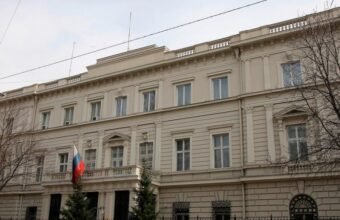












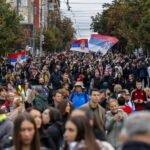







Last week, hundreds of people gathered on Friedrichstraße in central Berlin, outside the Russian House, to protest the German authorities’ decision to close the cultural centre. Many of those who addressed the rally openly expressed their anger at the government’s policy and warned of the consequences of further restricting Russian-German cultural ties.
I myself was inside the building and attended a Russian theatre performance there. Yet even during a cultural event, a sense of anxiety was palpable. The main question people were asking one another was simple: what happens next?
***
A number of prominent public figures, including well-known representatives of the former East Germany, also attended the rally and expressed solidarity with the Russian House. The reaction within German society shows just how deeply divided the country has become over its relationship with Russia.
The situation is being perceived particularly painfully in eastern Germany. For many East Germans, the closure of cultural institutions has become a symbol of a much broader political rupture with Russia. They ask a legitimate question: what do Russian culture, literary circles, language courses or children’s educational programmes have to do with the geopolitical conflict?
Source: Getty Images
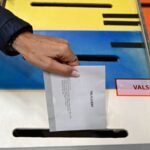
At the rally, one could also hear much sharper statements. Some participants said that, in protest against the current policies of the federal government, they were now prepared to vote for the Alternative for Germany, or AfD.
The paradox is that the German authorities apparently expected the opposite effect. The assumption was that tough measures and the constant portrayal of the AfD as a political force linked to Moscow would discourage voters from supporting the party. Liberal circles have long portrayed the AfD as a kind of “Moscow agency”, apparently believing that the Russian factor would discredit it in the eyes of the public.
Instead, the opposite seems to have happened. Pressure on Russian cultural institutions and increasingly confrontational rhetoric towards Russia have, for part of German society, particularly in the east, become not an argument against the AfD, but an additional reason to support it. The Russian issue is therefore turning into yet another factor driving Germany’s domestic political polarisation.
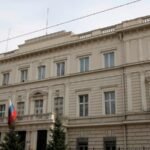
At the same time, a significant part of the German media, liberal NGOs and individual politicians from different political camps view the closure of Russian institutions very differently. Following the Russian House and Russia’s Consulate General in Bonn, attention is increasingly shifting towards other Russia-linked institutions, including cultural organisations in Dresden and even institutions associated with the Russian Orthodox Church.
Virtually any form of Russian presence is now increasingly being viewed through the prism of possible political influence. Discussions about culture, education and people-to-people contacts are gradually giving way to suspicions of political interference, intelligence activity and espionage. Psychologically, the atmosphere increasingly resembles that of the Cold War era.
The central problem is that the space for dialogue between Germany and Russia continues to shrink.
Official Berlin appears to believe that a diplomatic settlement of the conflict can only be pursued if Ukraine remains in a sufficiently strong position and does not lose on the battlefield. As a result, instead of looking for direct channels of political dialogue, the debate continues to focus on new sanctions and further arms deliveries to Ukraine.
This means further escalation.
Russia and Germany accuse each other of aggressive behaviour, while each side is convinced that it is merely responding to the actions of the other. A classic spiral of confrontation is emerging: one side’s actions are perceived by the other as a threat, prompting a response that, in turn, triggers yet another counter-response.
Nevertheless, I do not believe there will be a war between Russia and Germany. In my view, the situation will not escalate into a direct military confrontation. But the political and diplomatic rupture is already clearly visible. Relations between the two countries have been reduced to a minimum, traditional channels of communication are being dismantled one after another, and the space for normal diplomatic interaction is becoming increasingly narrow.
This is precisely where the main danger lies today — not in the inevitability of war between Russia and Germany, but in the gradual loss of the ability to talk to one another.
Source: AFP
It is particularly troubling when political confrontation begins to spill over onto ordinary people, culture and humanitarian ties.
Some of the most controversial recent statements by German politicians have concerned Russians and Russia’s presence in Germany. Such rhetoric, regardless of the political context in which it is used, only strengthens the perception of collective responsibility and contributes to the further alienation of the two societies.
Russian-German relations have already gone through periods of extremely severe confrontation. That is precisely why cultural, academic and public contacts have always been so important: they helped preserve at least some bridges at times when political relations had largely collapsed.
It is easy to destroy these bridges. Rebuilding them later is far more difficult.
Germany therefore faces a fundamental question: should political confrontation with the Russian state automatically mean abandoning Russian culture and cutting off social and cultural contacts with Russians?
It is entirely possible to be a strong opponent of Moscow’s policies while at the same time recognising the value of cultural dialogue. These positions are not mutually exclusive.
If culture itself ultimately becomes another instrument of geopolitical confrontation, Russian-German relations risk entering a prolonged period of estrangement whose consequences may last far longer than the current conflict.