























The incident involved a de Havilland DHC-6-400 Twin Otter operated by Air Antilles Express, performing flight 3S-722 from Pointe-à-Pitre in Guadeloupe to Saint Barthélemy. The aircraft was carrying seven people on board at the time of the accident, News.Az reports.
According to investigators, the plane landed on runway 28 at Gustaf III Airport at 11:42 local time after approaching from the sea. Shortly after touching down in the designated touchdown zone, the aircraft began drifting to the left side of the runway.
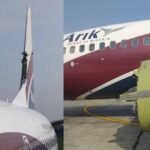
Despite attempts by the pilot flying to regain control using rudder, ailerons, and asymmetric reverse thrust, the aircraft continued to veer off the runway. The plane crossed a grassy area and ultimately collided with a helicopter parked on the apron, bringing it to a stop.
***
One person on board suffered minor injuries, while both the aircraft and the helicopter sustained substantial damage.
French aviation safety agency BEA (Bureau d’Enquêtes et d’Analyses) opened an investigation shortly after the accident, which occurred on August 24, 2023. The agency has now released its final report detailing the sequence of events and the technical factors behind the crash.
Investigators concluded that the nose wheel was not centered during landing, which caused the aircraft to deviate sharply to the left as soon as it touched the runway.
The report indicates that the Nose Wheel Steering (NWS) system was not properly locked in the centered position before landing. When the nose gear contacted the runway, the misaligned wheel caused the aircraft to immediately drift off course.
According to the findings, the flight crew were unaware of procedural updates introduced by aircraft manufacturer De Havilland in 2017. These updates required pilots to verify that the nose wheel steering system was locked in a centered position after takeoff and again before landing.
However, the airline’s operational manuals did not include the updated procedure, meaning the crew did not perform the full manual verification required to confirm the system was properly locked.
Investigators also found that the control cable tension in the nose wheel steering system was insufficient, though the exact reason for the incorrect adjustment could not be determined. This may have allowed the nose wheel to rotate during the flight even though cockpit indicators appeared aligned.
The report also highlighted several contributing factors that may have reduced the crew’s ability to detect the problem.
Among them were incomplete documentation updates by the airline, insufficient emphasis on the procedure during pilot training, and possible distractions in the cockpit during the landing checklist.
Investigators noted that the captain was experiencing an ear pressure compensation issue during descent, which may have distracted the crew during the critical checklist phase. The co-pilot was also handling multiple tasks simultaneously, potentially increasing workload and reducing attention.
In addition, the report pointed to fatigue caused by sleep deprivation in the days preceding the flight as another factor that may have affected the captain’s concentration.
The accident once again highlights the operational challenges at Saint Barthélemy’s Gustaf III Airport, known for its short runway and demanding approach over the hillside before landing near the shoreline.
Although the incident caused only minor injuries, investigators say it underscores the importance of strict adherence to updated aircraft procedures and training standards, particularly for aircraft operating in demanding airport environments.