










“This symbolic milestone reinforces Tesla’s autonomy lead, but with capex doubling and FCF [free cash flow] turning negative, investors will need clearer evidence that unsupervised autonomy is around the corner to support the stock’s valuation,” Morgan Stanley said in a note titled “1Q26 Preview: Countdown to 10 Billion FSD Miles” dated April 10, News.Az reports, citing foreign media.
***
The Path to ‘Unsupervised’ (Robotaxi) Autonomy: FSD 15
On the upcoming release of FSD Version 15, Morgan Stanley said that “expanded model parameters and improved data collection should help unlock unsupervised FSD (V15).” Translation: FSD v15 needs to be successful to get Tesla to the promised land of a true driverless (unsupervised) vehicle.
Note that Tesla CEO Elon Musk stated on X earlier this month that the “10x parameter” model won’t arrive until version 15. Musk said: “Our rate of advancement with the small model has been so fast that the large model has not yet caught up. V15 will be the large model.” Translation: the larger AI neural network model for FSD, which has roughly 10 times more parameters than the current “small” model, isn’t ready yet. Tesla’s latest version of FSD, v14.3, does not accommodate that larger model. Musk has made bullish statements about every version of FSD. Most recently saying that “Version 14 of Tesla self-driving feels sentient.”
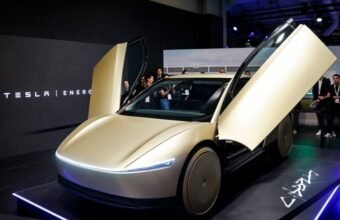
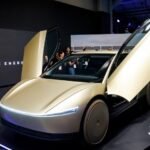
FSD is the core AI/software stack that powers Tesla’s Robotaxi (Cybercab) service. Robotaxi is essentially the commercial application/deployment of advanced FSD in a ride-hailing network.
Despite initial enthusiasm for the Robotaxi in Austin, Texas, things have leveled off. “Excitement built following the first sightings of an unsupervised robotaxi in Austin, Texas, but the subsequent roll-out has admittedly gone slower than expected,” Morgan Stanley said.
“Bears argue that this is a signal that Tesla’s technology doesn’t work. We believe it is far too early to draw that conclusion,” Morgan said. “Instead, we believe the issues that Tesla is still working through (pickup and dropoff) are actually quite solvable, but are robotaxi-specific functions which take time to develop given more limited data collection.” The note added: “We remain optimistic that Tesla will be able to demonstrate improvements in this area of their robotaxi operations, which should translate into more unsupervised vehicles on road throughout 2026.”
‘Consequential Task’ ahead for robotaxi
With Tesla on pace to surpass 10 billion cumulative FSD miles by late May, Morgan Stanley noted “the consequential task of scaling an unsupervised robotaxi fleet.” The note continued: “In a year when capex is set to more than double and FCF is flipping negative, we believe Tesla’s ability to demonstrate tangible progress in scaling unsupervised autonomous driving capabilities will be critical in supporting valuation.” (Morgan Stanley notes that Tesla owners are driving 18.5 million miles with FSD every day, putting the company on pace to surpass the 10 billion cumulative FSD miles, cited above, by late May. That number was updated on Friday to over 19 million miles per day.)