





















The decision to summon the Polish ambassador to Azerbaijan’s Ministry of Foreign Affairs came as an unpleasant surprise in the context of bilateral relations, particularly against the backdrop of statements made during the June meeting between Azerbaijani Foreign Minister Jeyhun Bayramov and his Polish counterpart, Radosław Sikorski.
The Polish diplomat was summoned over a provocative segment aired by Poland’s public broadcaster TVP, specifically on TVP World’s Eastern Express programme. According to Azerbaijan’s Foreign Ministry, the broadcast contained biased, distorted and wholly unacceptable claims about the Azerbaijani state and its leadership.
In addition to the content itself, the provocative conduct of the programme’s host caused particular concern.
***
Nothing appeared to foreshadow such a deterioration in bilateral relations. There seemed to be no reason for this kind of provocation on Polish television. Yet it is difficult to escape a sense of déjà vu: the controversial segment followed a scandal triggered by a similar provocation in the Russian media.
It creates the impression that this succession of attacks is being deliberately financed and promoted by someone. It is nevertheless remarkable that Poland and Russia have found themselves in the same chain of events — two countries that openly demonstrate hostility towards each other and constantly exchange accusations.
Moscow and Warsaw regularly clash over Ukraine. But if one looks beneath the surface, the picture appears to be painted in very different colours.
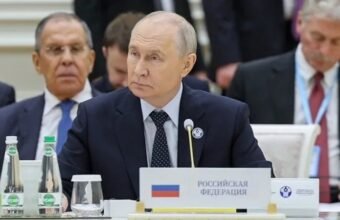
When Vladimir Putin stated a month ago that “Ukraine will be divided into parts, and Poland wants its share,” the Polish Foreign Ministry reacted indignantly, insisting that Warsaw had no designs on Ukrainian territory. Those assurances, however, may be questioned because voices in Poland have never entirely concealed the belief that certain Ukrainian territories historically belong to Poland.
Source: Shutterstock
The fact that these claims are not expressed officially does not mean that the broader body of expert commentary, historical interpretation and public sentiment surrounding the issue can simply be ignored. A number of Russian commentators argue that Poland may be no less interested than Russia in Ukraine’s defeat, because such an outcome could allow Warsaw to gain control over territories it regards as historically Polish. According to these commentators, such ambitions may not be limited to Ukraine’s western regions.
Despite Warsaw’s vehement rejection of Putin’s claims about alleged plans to partition Ukraine, such historical claims occasionally surface at the state level as well. In July, Zbigniew Bogucki, head of the Chancellery of the President of Poland, referred to Ukraine’s western regions as “Lesser Poland” while commenting on the Volhynia tragedy. The remark caused a scandal and further tension with Kyiv.
The chancellery chief’s supposed “slip of the tongue” was no coincidence. It reflects a broader anti-Ukrainian trend operating at various levels of Polish society. At the official level, it surfaces only rarely, usually when Warsaw wishes to remind Kyiv of what it considers Ukraine’s proper place.
Within Polish society, however, the situation is deteriorating by the day. Despite its public display of strong support for Ukraine, Poland is making little effort to conceal the contradictions in its position.
According to Rzeczpospolita newspaper, anti-Ukrainian sentiment is intensifying in Poland. In mid-July, the publication reported that police had recorded a 30 per cent increase in reports of hate crimes against Ukrainian citizens over the previous six months compared with the same period a year earlier.
The reported incidents included the verbal harassment of Ukrainian teenagers on a bus in Bielsko-Biała and a brutal assault on a Ukrainian couple in Wrocław. Anti-Ukrainian rhetoric is also becoming increasingly visible in Poland’s information space. A report prepared by Press Club Polska and Data House Res Futura found that, in May, only one in every thousand publications concerning Ukraine was favourable.
Right-wing politicians have also called for Ukrainians of military age to be deported from Poland. In early August, IBRiS conducted a survey commissioned by Rzeczpospolita in which 67.2 per cent of respondents supported such a proposal.
During a European Parliament debate on Ukraine’s progress towards EU membership on 8 July, MEP Ewa Zajączkowska-Hernik, representing the Confederation political alliance, declared that “we Poles must never agree to Ukraine joining the EU,” according to Euronews.
A series of high-profile attacks occurred during the summer, including the beating of a Ukrainian married couple in Wrocław. The violence eventually forced Prime Minister Donald Tusk to issue a public appeal for an end to xenophobic attacks.
Yet in March, Tusk’s own government adopted legislation scaling back some support measures for Ukrainian citizens. Among other things, the law restricted access to free accommodation in collective reception centres for people deemed capable of working. The changes also affected access to free healthcare for certain categories of refugees.
Poland has failed to adapt to the fact that Ukraine is no longer viewed merely as a victim of Russian aggression and a recipient of Western assistance, but has become an independent actor with its own interests and ambitions. According to the Ukrainian website Gordon, Polish journalist Mateusz Mazzini made this argument in a column for The Guardian published on 26 August.
“Poland has failed to fully recognise that Ukrainians are not merely helpless victims of Vladimir Putin, but real people capable of determining their own lives,” the author wrote.
Ukraine, he argued, no longer needs Poland to act as its “advocate” in the West. Instead of preparing Polish society for the prospect of Ukrainians becoming a fully integrated part of it, Donald Tusk’s government has continued to promote the idea that Poland has a special role to play in Ukraine’s future.
Polish society and the government are apparently not only unprepared for the growing activity of Ukrainians but also increasingly alarmed by it. The figures are indeed striking: Ukrainians account for roughly two-thirds of all employed migrants in Poland, while their employment rate has reached 83 per cent. Ukrainian-owned businesses account for approximately 10 per cent of all newly established companies in the country.
Ukrainian migrants have proven talented, active and entrepreneurial — and this has begun to unsettle and irritate parts of the host society. Unfortunately, xenophobia is nothing new in Poland. Ukrainians are not the only ones who experience it; Muslims face similar hostility.
Islamophobia in Poland manifests itself through hostility, prejudice and fear directed towards Islam and Muslims. This is despite the fact that the country’s Muslim community has historically been extremely small, accounting for less than 0.1 per cent of the total population.
The historical core of Poland’s Muslim community consists of Polish Tatars, who have lived there for centuries. The story of how the Tatars came to Polish lands is both noteworthy and revealing. The first Tatars arrived in the Grand Duchy of Lithuania and the Polish–Lithuanian Commonwealth in the 14th century at the invitation of the grand dukes, serving as allies and warriors.
Renowned for their courage and military skill, the Tatars defended the state’s borders and were rewarded with land and noble privileges. They distinguished themselves in the war against the Teutonic Order, including at the Battle of Grunwald in 1410. Three centuries later, however, their service had been forgotten: the Polish nobility began questioning their right to noble status and stopped paying Tatar soldiers.
Today, Poland appears reluctant to remember the role that the Tatars played in defending its borders and preserving its statehood. Although the Muslim population remains extremely small and poses no threat whatsoever to the foundations of the Polish state, Poland regularly ranks among the European countries with the highest levels of anti-Muslim sentiment, according to international opinion surveys, including studies conducted by the Pew Research Center.
Xenophobia is a dangerous instrument employed in the name of preserving the supposed “purity” of society. Once it becomes part of politics, it rarely remains directed at a single target. It eventually spreads to anyone with a different skin colour or religion, as well as to anyone perceived as owing the country something.
Source: iStock
From the perspective of some circles in Poland, Ukraine owes Poland something — namely, the territories incorporated into the Soviet Union after the Second World War that later became part of independent Ukraine. Territorial claims are a political affliction much like xenophobia. Both are difficult to overcome and can shape relations between nations for decades, or even centuries, unless political leaders make a conscious effort to stop them.
Poland has traditionally viewed Ukraine as a “prodigal son” that must eventually return to its “father.” The attitude has long been patronising and arrogant. During the first years of Russia’s aggression against Ukraine, Poland assumed the role of Kyiv’s principal advocate and sought to present itself as the main negotiator and arbiter of the situation.
Russia did not accept Poland in that capacity. Over time, as Ukraine strengthened and received extensive international assistance, Kyiv also sought to free itself from Warsaw’s tutelage. This was because the supposed guardianship was never entirely sincere. Poland was prepared to pity Ukrainians, but it was never prepared to treat them as equals.
Returning to the issue raised at the beginning, the regrettable situation provoked by the Polish television channel once again demonstrates that such behaviour is not an isolated incident but part of a broader pattern.
We understand why provocations against Azerbaijan may appear in the Russian media. What is far more difficult to understand is why insults and defamatory claims targeting Azerbaijan were voiced in such a provocative manner on Polish television.
There are no serious disputes between Azerbaijan and Poland that could make the incitement of hostility towards Azerbaijan politically advantageous. Yet Poland appears unable to break free from this pattern — or perhaps it simply has no desire to do so.