


























***
If successful, the maneuver would mark the first time a vertically launched spacecraft has completed an orbital mission and returned to its original launch site for recovery.
The spacecraft is designed to be caught by giant mechanical arms attached to the launch tower, a system SpaceX hopes will eventually enable the rapid reuse of its rockets.
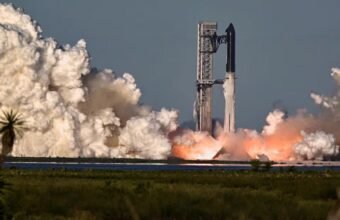
Starship launched on Friday, November 13, aboard the Super Heavy booster, beginning a mission expected to last 22 hours and 32 minutes and complete 14 orbits around Earth.
The spacecraft has been traveling at an altitude of approximately 260 kilometers (161 miles).
However, SpaceX encountered an early setback when the Super Heavy booster failed to return to the launch pad about 10 minutes after liftoff because of a suspected onboard navigation problem.
The failure prevented the company from achieving its original goal of recovering both stages of the rocket during the same mission.
Despite the setback, the 15th test flight has already become Starship’s longest mission, surpassing the approximately three-hour flight conducted in September, when the spacecraft reached orbit for the first time.
SpaceX has spent about a decade developing Starship, which CEO Elon Musk envisions as the foundation of the company’s future satellite-launch operations and ambitions to transport humans to the Moon and eventually Mars.
Unlike SpaceX’s Falcon 9 rocket, whose first stage is reusable but second stage is discarded, Starship is being designed as a fully reusable transportation system.
The Super Heavy booster has previously been successfully recovered using the launch tower’s mechanical arms on three occasions, most recently in March 2025.
A successful recovery of Starship’s upper stage would represent another major milestone in SpaceX’s efforts to develop a fully reusable rocket system capable of significantly reducing the cost of space transportation.
As of the latest report, the spacecraft’s landing attempt had not yet been completed.