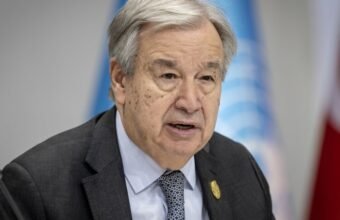



























Addressing a high-level open debate of the UN Security Council on conflict resolution amid rapid technological change, Guterres said AI offers opportunities to improve conflict prevention, peacekeeping and humanitarian operations. However, he stressed that its expanding military applications pose serious risks, Anadolu Agency reported.
“Machines that select targets and take lives without human control are morally repugnant and politically unacceptable. Killer robots must have no place in our future,” Guterres said.
***
He reiterated his call for urgent negotiations on a legally binding instrument governing lethal autonomous weapons systems, insisting that humans must retain control over all life-and-death decisions on the battlefield.
Guterres also warned against allowing AI to become an excuse for avoiding responsibility when civilians are killed or international law is violated.
“The answer must never be ‘the algorithm did it’,” he said.
The UN chief outlined three major threats to international peace and security linked to the rapid development and deployment of AI.
The first is its growing use in military operations, including intelligence gathering and target selection. He warned that increasingly autonomous military capabilities are becoming accessible to both state and non-state armed groups, raising concerns across cyberspace, outer space and the life sciences.
Guterres also called on technology companies to recognize their potential legal responsibilities when their products or services contribute to violations of international law, humanitarian law or human rights.
The second threat is the use of AI to spread disinformation and manipulate public opinion. Guterres warned that fabricated audio and video could undermine peace processes or incite violence, with women politicians, peacemakers and leaders often targeted by misogynistic campaigns.
He called for coordinated responses involving technology companies and local communities to identify disinformation, rebuild trust and reduce tensions.
The third risk is what he described as an increasingly uncontrolled race for AI, driven by commercial interests and geopolitical rivalry. Growing demand for energy, water, critical minerals and industrial capacity is creating new tensions within and between countries, he said.
Guterres also warned that developing countries have had little influence over technologies that will increasingly shape their economies and societies.
“We cannot allow an AI divide to instigate other types of divides,” he said.
Despite these concerns, the secretary-general highlighted the potential benefits of AI for peace and humanitarian work. Applications include predicting food insecurity and disaster-related displacement, detecting and clearing landmines, and using uncrewed systems to evacuate wounded people from areas inaccessible to medical teams.
AI could also improve UN peace operations through better logistics, maintenance, situational awareness and operational planning. Faster analysis of information could support mediation efforts and civilian protection, while digital tools could enable mediators to engage much larger sections of the public in peace processes.
However, Guterres stressed that technology cannot replace the human relationships and trust needed to resolve conflicts.
He urged countries to strengthen international cooperation through the Global Dialogue on AI Governance and the Independent International Scientific Panel on AI, calling for common standards, shared methods to assess risks and credible independent oversight.
He also advocated confidence-building measures, including direct communication channels between countries to reduce the risk of misunderstandings, miscalculations and escalation.
Drawing comparisons with aviation, medicine and nuclear energy, Guterres said public confidence in powerful technologies depends on effective oversight and accountability.
“The same standard must apply to artificial intelligence,” he said.
Guterres said the debate ultimately concerned who controls AI, who benefits from it and who bears the consequences when it is left unchecked.
“The founders of this organization could not have imagined artificial intelligence. But they understood that power must answer to law – and that peace is a human choice. Let us ensure it remains one,” he said.