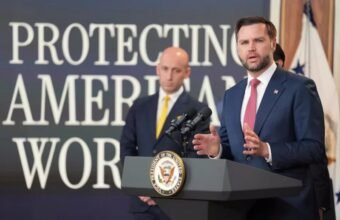



























The measures, announced Thursday, are part of President Donald Trump’s broader effort to tighten immigration rules and address what his administration describes as fraud and practices that disadvantage American workers, Reuters reported.
US Vice President JD Vance accused Microsoft of abusing the immigration system, saying the company laid off 6,000 American workers last year while benefiting from 6,300 H-1B temporary worker visas and nearly 3,000 green cards.
***
“There has been no company in the United States, unfortunately, that has abused the system more than Microsoft,” Vance said.
The suspension affects applications under the permanent labor certification, or PERM, process, which most employment-based green-card applications require. Under the program, employers must demonstrate that hiring a foreign worker would not adversely affect the wages or employment opportunities of US workers.
US Labor Secretary Keith Sonderling said the suspension also covers Cognizant, Infosys, Tata Consultancy Services, Wipro, HCL Technologies and Capgemini.
“We will not accept any new or process any pending permanent labor certification applications involving these companies,” Sonderling said.
He said the companies had sought nearly three million foreign workers since 2009 and received more than 230,000 H-1B visa approvals and over 100,000 permanent labor certifications.
Vance said the suspensions would remain in place “as long as it needs to,” adding that the administration wanted the companies to change their hiring practices. He accused some employers of using ineffective job advertisements to justify recruiting foreign workers at lower wages.
Microsoft said about 80% of its H-1B applications in the last fiscal year were filed to extend or change the status of existing employees rather than recruit new workers. The company also said it pays H-1B employees the same as other workers performing comparable jobs.
Microsoft announced in July that it would cut 4,800 jobs, representing about 2.1% of its global workforce.
Adobe and several of the other companies named did not immediately respond to requests for comment, while Tata Consultancy Services declined to comment. India’s IT industry body, Nasscom, said Indian technology companies operating in the US had significantly reduced their reliance on H-1B visas and that relatively few of their employees sought green cards through the PERM process.
The move follows a separate immigration measure introduced last year that imposed a one-time $100,000 fee on new H-1B petitions for workers hired from abroad.
The Labor Department launched an enforcement initiative called Project Firewall in September 2025. The department said the initiative had opened about 200 cases and resulted in millions of dollars in penalties.
Alongside the corporate suspensions, the administration announced investigations into nine universities, including Harvard, Yale, Stanford, Brown and the Massachusetts Institute of Technology.
Vance said the institutions were being investigated over alleged misuse of exchange-visitor visas to undercut American wages. Labor Department Inspector General Anthony D’Esposito said subpoenas had already been issued.
Investigators will examine whether foreign influence, improper financial relationships or visa abuse have compromised federally funded research, D’Esposito said.
The investigations could have wider implications for US universities, which rely on international students and researchers. Sarah Spreitzer, a vice president at the American Council on Education, said international students historically spent about $40 billion annually in the United States.
The latest action adds to the administration’s ongoing dispute with Harvard over international students and immigration compliance. Last year, the Department of Homeland Security subpoenaed the university over alleged misconduct by international students and its compliance with immigration law. Harvard described the subpoena as “unfounded retribution” but said it would comply to the extent required by law.
Changing visa policies have also affected international admissions. Reuters previously reported that a decline in international applications contributed to Columbia University pausing admissions to one of its journalism programs.
The latest measures broaden the administration’s scrutiny of employment-based immigration and international academic programs, potentially affecting both technology companies’ recruitment strategies and universities’ access to foreign talent.