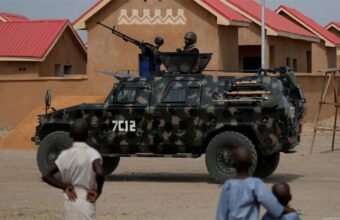























Nigerian police initially confirmed 10 deaths, but the human rights organisation reported that additional bodies were recovered on Saturday, raising the reported death toll to at least 40 and highlighting the continuing threat posed by armed violence in rural communities, News.Az reports.
***
The attack occurred in Binnari, in the Karim Lamido Local Government Area, where residents described gunmen arriving in large numbers and unleashing sustained gunfire.
Witnesses reported that attackers stole food, money and other supplies, while some houses and shops were set ablaze. Several residents fled to neighbouring communities for safety.
The identities of the attackers and their motives have not been established. Nigerian authorities deployed additional security personnel to the area as investigations continued.
Amnesty International condemned the killings and called for an impartial investigation and accountability for those responsible. The organisation also expressed concern about the continuing vulnerability of rural populations to armed attacks.
News.Az examines how the Binnari massacre unfolded, why casualty estimates differ, who may be responsible, the wider insecurity affecting northern Nigeria and the measures needed to protect vulnerable communities.
What happened during the deadly attack on Binnari village?
The attack took place on Friday, October 23, in Binnari village, located in the Karim Lamido Local Government Area of Taraba state.
According to Nigerian police, a large group of armed men entered the community and began firing repeatedly, creating panic among residents.
Witnesses told local and international media that the attackers arrived on motorcycles shortly after Friday prayers.
One community leader told AFP that the assailants travelled on approximately 50 motorcycles, with two men on each vehicle.
Although that estimate has not been independently verified, it suggests that residents encountered a substantial armed group rather than a small number of attackers.
The gunmen reportedly moved through the village, targeting residents and looting shops.
Food supplies, money and motorcycles were among the items said to have been taken.
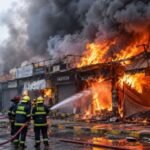
Amnesty International also reported that houses, commercial premises and food stocks were burned during the assault.
Residents fled in different directions, while others remained behind to search for relatives and recover victims.
Police confirmed that officers responding to the incident initially recovered 10 bodies with gunshot wounds.
Further searches subsequently revealed additional victims, according to Amnesty International.
The violence left surviving families facing immediate concerns about shelter, food and personal security.
Authorities have not yet established the attackers’ identities, their affiliations or the specific motive behind the raid.
The available evidence therefore does not justify attributing responsibility to any particular organisation.
Why did police initially report 10 deaths while Amnesty International counted at least 40?
The difference between the initial police casualty figure and Amnesty International’s subsequent estimate reflects the difficulties of establishing accurate death tolls immediately after violent attacks.
On October 24, the Taraba State Police Command confirmed that 10 bodies had been recovered following the assault on Binnari.
Police spokesperson Victor Mshelizah said security personnel had been deployed to the community.
However, Amnesty International later reported that at least 40 people had been killed, citing additional bodies discovered during searches on Saturday.
The organisation warned that some residents remained missing, raising concerns that the total number of victims might not yet have been established.
Survivors interviewed by AFP separately reported recovering more than 20 bodies after the attackers left.
These differing figures do not necessarily indicate that the organisations are describing separate incidents.
Instead, they reflect information collected at different stages of the response and through different reporting channels.
In rural communities, casualty verification can be complicated by damaged infrastructure, difficult access, population displacement and the urgent burial of victims.
Witnesses may also have incomplete information about deaths occurring in different parts of a village.
Amnesty International reported that some bodies had been burned beyond recognition, creating additional difficulties for identification.
Its estimate of at least 40 deaths should therefore be understood as a reported minimum, not a final independently verified count.
A comprehensive assessment will require coordinated searches, identification of victims and the reconciliation of police, medical and community records.
Who are the armed groups operating in northern Nigeria?
Northern Nigeria has experienced persistent violence involving criminal gangs, armed militias and insurgent organisations operating across different regions.
The term bandits is commonly used in Nigeria to describe heavily armed criminal groups involved in village raids, kidnapping for ransom, livestock theft and attacks on rural communities.
Such groups are particularly active in parts of northwestern and north-central Nigeria, although similar insecurity affects other states.
Their activities frequently involve attacks on settlements where police and military personnel cannot respond quickly.
Some groups demand payments from farmers, traders and local communities, while others steal livestock, food and commercial goods.
The economic consequences can be severe because repeated attacks discourage farming, disrupt local markets and force residents to abandon their livelihoods.
Nigeria also faces a separate but overlapping insurgency involving Boko Haram and the Islamic State West Africa Province, especially in the northeast.
These organisations have ideological objectives that distinguish them from many criminal gangs primarily involved in extortion, kidnapping and theft.
However, the presence of multiple armed actors complicates the country’s security environment.
Groups may operate across administrative boundaries, exploit local grievances or take advantage of weak state institutions.
In the Binnari attack, the identities and affiliations of the assailants remain unknown.
Although the raid involved methods associated with bandit attacks, including motorcycle movements, heavy gunfire and looting, those similarities are insufficient to identify the perpetrators conclusively.
Investigators will need to examine witness accounts, forensic evidence and intelligence findings before assigning responsibility.
How has persistent armed violence affected civilians and rural communities in Nigeria?
The Binnari killings illustrate the wider humanitarian consequences of armed violence in northern Nigeria, where isolated communities often face repeated attacks and limited access to emergency assistance.
For rural populations, insecurity threatens far more than personal safety.
Agriculture, livestock production and local trade provide essential income for many families, making attacks on farms, markets and villages particularly destructive.
When gunmen steal food supplies or livestock, households may lose both their immediate resources and the means of sustaining themselves in the future.
The destruction of homes and shops also places additional pressure on communities already struggling with poverty and limited public services.
Residents who survive attacks frequently flee to neighbouring settlements, where relatives and host communities may lack sufficient resources to accommodate them.
Displacement can interrupt children’s education, restrict access to healthcare and increase pressure on water supplies and housing.
Fear of further violence may also discourage farmers from returning to their fields, reducing agricultural production and contributing to food insecurity.
Amnesty International has repeatedly criticised the inability of authorities to provide effective protection for vulnerable rural populations.
Following the Binnari attack, the organisation called for accountability and assistance for survivors.
The consequences are particularly serious when families cannot establish what happened to missing relatives.
Uncertainty surrounding casualties can prolong suffering and complicate recovery efforts.
Beyond emergency security deployments, affected communities require medical assistance, psychological support, shelter and help restoring livelihoods.
Without sustained protection, repeated attacks risk creating cycles of displacement, economic hardship and further insecurity.
What can Nigerian authorities do to prevent further attacks on vulnerable villages?
Preventing attacks similar to the Binnari killings requires a combination of immediate security measures, effective criminal investigations and longer-term efforts to address the conditions that allow armed groups to operate.
Following the October 23 assault, the Taraba State Police Command announced the deployment of additional personnel to the affected area.
According to police statements, the response involved tactical officers, the Police Mobile Force, conventional police units, the Nigerian Army and other security agencies.
Such deployments can help restore order and reassure residents, particularly when communities fear that attackers may return.
However, temporary security operations alone may not resolve the underlying threats.
Rural communities often require more reliable early-warning systems, better communication with law enforcement and faster emergency response capabilities.
Improved coordination between local authorities, police and military units could help identify threats before armed groups reach populated areas.
Investigations must also establish who organised the Binnari attack and whether the perpetrators were involved in earlier incidents.
Taraba State Governor Agbu Kefas condemned the killings and called for those responsible to be identified and brought to justice.
Holding perpetrators accountable is important because repeated attacks without effective prosecution can undermine public confidence in security institutions.
Authorities must also ensure that security operations respect human rights and do not expose innocent residents to further harm.
Longer-term policies addressing economic marginalisation, local disputes and opportunities for criminal recruitment may complement security measures.
For the survivors, immediate priorities include recovering missing relatives, obtaining medical treatment and rebuilding damaged homes and businesses.