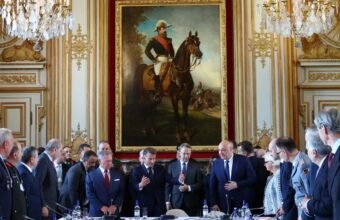














Macron hosted Aoun and Jordan’s King Abdullah II for an “Aqaba Process” meeting focused on international support for the Lebanese Armed Forces (LAF). Senior military officials from Lebanon, France, Jordan, the United Kingdom and Italy, along with US and Saudi officials, also joined the discussions, Al Jazeera reported.
The French presidency said the meeting was intended to review a Lebanese army deployment plan based on a “clear, credible and realistic” framework. Paris said clarifying the operational requirements of the deployment would be important for securing international support through financial assistance, equipment and training.
***
Macron said the talks were aimed at strengthening Lebanon’s sovereignty and enabling the country to provide security across its territory. He also described the Lebanese army as essential to reinforcing the authority of the Lebanese state.
Aoun’s office said the Lebanese president and Macron also discussed efforts to end Israeli attacks in the context of Lebanese-American-Israeli negotiations and the US-mediated framework agreement reached in June.
Aoun described the Lebanese army as the main pillar for protecting the country’s sovereignty and said strengthening state authority was a Lebanese choice. He also reiterated his position that weapons should be held only by the state and said he wanted Hezbollah’s disarmament to proceed without confrontation, according to the Lebanese presidency.
The June framework agreement envisages the gradual withdrawal of Israeli forces from southern Lebanon, the deployment of the Lebanese army in the area and the disarmament of Hezbollah. Implementation of the agreement has stalled, however, while Israeli forces remain in parts of southern Lebanon and attacks have continued.
The Paris talks also focused on arrangements for southern Lebanon after the mandate of the United Nations Interim Force in Lebanon (UNIFIL) expires at the end of 2026.
UNIFIL has operated in Lebanon for nearly five decades and currently has just under 7,500 peacekeepers from 46 countries. France and Italy have proposed a multinational force to succeed the UN mission, while other options, including a possible European Union-led presence, are also being discussed.
The proposed alternatives would focus on supporting the Lebanese army through training, equipment, intelligence-sharing and mentoring, according to Reuters.
Aoun told AFP earlier this week that Lebanon wanted an international force, whether European or otherwise, to prevent a security vacuum after UN peacekeepers leave southern Lebanon.
The discussions come amid continued tensions along the Israel-Lebanon border. Reuters reported that Israeli and Lebanese officials are due to meet in Rome in October as part of efforts to advance the US-brokered security framework.