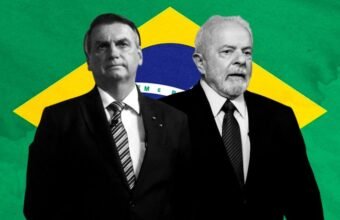
























Lula, 80, is seeking a record fourth term as president and could bring his total time in office to 16 years if re-elected. His main challenger, Flávio Bolsonaro, 45, is seeking to succeed his father, former President Jair Bolsonaro, and continue the political movement built by the former leader, Bloomberg reported.
The election is taking place in a deeply polarized Brazil, Latin America’s largest economy, with neither candidate expected by most polls to secure the majority needed to win the presidency outright in the first round.
***
Lula closed his campaign Saturday with a march through São Paulo, where his campaign said a large crowd gathered for his final rally.
“Tomorrow, we’re going to win the elections in the first round,” Lula told supporters, framing the contest as a choice between “democracy and barbarism” and promising to defeat the far right.
He has also made national sovereignty a central theme of his campaign, warning against what he described as potential interference from Washington.
Flávio Bolsonaro ended his campaign with a motorcycle caravan through towns in São Paulo state before holding a rally in Rio de Janeiro. The event echoed the campaign style of his father, who remains an influential figure among Brazil’s right-wing voters.
“I am convinced that everything is in place for us to win this election in the first round,” Bolsonaro said.
His father, Jair Bolsonaro, is serving a 27-year prison sentence after being convicted over efforts to overturn his defeat by Lula in the 2022 presidential election.
US President Donald Trump has not formally endorsed Flávio Bolsonaro but has said he is watching the election “very closely.” His interest has become a contentious issue in the campaign, with Lula’s supporters accusing Washington of attempting to influence Brazil’s political process.
The Bolsonaro campaign has also faced scrutiny over a film-financing controversy involving Dark Horse, a planned biopic about Jair Bolsonaro. Flávio Bolsonaro is under investigation in connection with the financing of the project, which was reportedly backed by a jailed banker linked to one of Brazil’s major financial scandals.
Brazil’s Supreme Court authorised federal police in April to investigate whether Flávio Bolsonaro made defamatory statements about Lula.
The senator has pledged to seek his father’s release if elected. He has also echoed his father’s unsubstantiated claims questioning the reliability of Brazil’s electronic voting system, raising concerns among analysts that such arguments could be used to challenge the result if he loses.
The presidential contest is only part of Sunday’s vote. Brazilians will also elect governors in all 26 states and the Federal District, 54 of the Senate’s 81 members, all 513 members of the lower house and hundreds of state and district lawmakers.
The congressional results will be crucial for the next president’s ability to pass legislation and advance an agenda, while gubernatorial races will help determine the distribution of political power across Brazil.
The Senate election is particularly significant because the upper chamber has constitutional authority to conduct impeachment trials of Supreme Court justices. That role has gained additional importance amid tensions surrounding the court and scrutiny of some justices’ alleged ties to Daniel Vorcaro, owner of Banco Master, a midsized lender at the center of a major corruption investigation.
Polls indicate that Lula remains ahead but that his advantage over Bolsonaro has narrowed. If neither candidate wins a majority of valid votes, the two leading candidates will advance to a runoff scheduled for October 25.
The race is considerably tighter than Lula’s 2022 victory, when he defeated Jair Bolsonaro by less than two percentage points.
The outcome will determine not only who leads Brazil for the next four years but also the balance of power in Congress and across the country’s states, making Sunday’s election one of the most consequential political contests in Brazil in years.