



























***
Table Of Content
- Why are China and Cambodia conducting their largest-ever joint military exercises?
- Why is Cambodia’s Ream Naval Base attracting growing attention from the United States?
- How could the Golden Dragon exercises influence security in Southeast Asia and the South China Sea?
- Why is Cambodia strengthening military ties with China while restoring cooperation with the US?
- What could the expanded China-Cambodia military partnership mean for regional stability?
The eighth edition of the exercises will continue until December 9, focusing on counterterrorism, anti-piracy operations, humanitarian assistance and disaster relief.
More than 2,900 military personnel are participating, including approximately 1,300 Chinese troops. The exercises involve land, naval and air forces operating across three locations in Cambodia.
Although Cambodian authorities insist the activities do not threaten other countries, the growing scale of the drills highlights China’s strengthening military partnership with Phnom Penh and renewed international attention to the strategic importance of Ream Naval Base.
Why are China and Cambodia conducting their largest-ever joint military exercises?
The Golden Dragon 2026 exercises represent the latest stage in expanding military cooperation between China and Cambodia, which have developed increasingly close political and defense relations.
According to Cambodian military officials, more than 2,900 personnel are participating, making this the largest edition of the exercises since they began in 2016.
Approximately 1,300 Chinese troops are involved, compared with around 900 Chinese personnel who participated in the previous year’s drills.
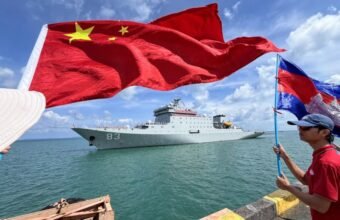
The exercises include joint operations involving warships, helicopters, drones, armored vehicles, artillery and military command systems.
China’s Ministry of National Defense says the activities are designed to improve coordination in counterterrorism, anti-piracy missions and humanitarian relief.
The programme also includes practical training intended to strengthen communication between military units operating on land, at sea and in the air.
Beyond technical cooperation, the expanded exercises demonstrate the importance both governments attach to their defense relationship.
However, neither government has described the drills as preparation for military operations against another country.
Why is Cambodia’s Ream Naval Base attracting growing attention from the United States?
Ream Naval Base occupies a strategically important position on Cambodia’s southern coast, providing access to the Gulf of Thailand and maritime routes connecting mainland Southeast Asia with international shipping networks.
China has financed substantial improvements to the facility, including infrastructure capable of accommodating larger naval vessels.
The modernization has prompted concerns in Washington that Beijing could eventually secure privileged military access to a strategically located naval installation.
Such access could potentially expand China’s ability to support naval operations beyond its immediate coastline and strengthen its presence near important Southeast Asian maritime routes.
However, Cambodia has repeatedly rejected allegations that Ream is intended to become an exclusive Chinese military base.
Cambodian officials maintain that the upgraded facility remains under national sovereignty and is accessible to warships from friendly countries.
In January 2026, the American warship USS Cincinnati visited Ream, demonstrating that the base was not reserved exclusively for Chinese vessels.
The long-term arrangements governing Chinese naval access nevertheless remain an important subject of international scrutiny.
How could the Golden Dragon exercises influence security in Southeast Asia and the South China Sea?
The exercises are taking place against the backdrop of increasing strategic competition between China and the United States in Southeast Asia.
China has sought to strengthen its military partnerships with regional countries through training, equipment supplies and infrastructure development.
Cambodia is among Beijing’s closest regional partners and has consistently supported cooperation with China across diplomatic, economic and security matters.
The location of Ream Naval Base adds a geopolitical dimension because the facility provides access to the Gulf of Thailand, relatively close to maritime routes linking the wider region to the South China Sea.
Although the exercises do not directly concern territorial disputes in the South China Sea, greater Chinese military access to regional facilities could influence future security planning.
Cambodian Defense Minister Tea Seiha emphasized that the drills were not intended to threaten or negatively affect any third country.
Chinese officials likewise described the programme as a contribution to mutual military trust and operational cooperation.
The broader strategic implications will depend on how the bilateral military relationship develops.
Why is Cambodia strengthening military ties with China while restoring cooperation with the US?
Cambodia’s military diplomacy reflects an effort to maintain its longstanding relationship with China while reopening channels of defense cooperation with the United States.
China provides substantial military assistance, training, equipment and infrastructure support to Cambodia.
The Golden Dragon exercises have become an important symbol of this relationship, allowing Cambodian forces to gain experience operating alongside Chinese military units.
However, Phnom Penh has also taken steps to improve relations with Washington.
Cambodia previously conducted the Angkor Sentinel exercises with the United States, but the programme was suspended in 2017 as bilateral relations deteriorated.
In August 2026, Prime Minister Hun Manet announced plans to resume the exercises, with the next edition expected in February 2027.
The January visit by the USS Cincinnati to Ream Naval Base was another indication of renewed military engagement.
These developments suggest that Cambodia is not limiting its defense relationships exclusively to China.
Nevertheless, Beijing remains a particularly important military partner, and the balance between these relationships continues to attract international attention.
What could the expanded China-Cambodia military partnership mean for regional stability?
The immediate objective of Golden Dragon 2026 is to strengthen the ability of Chinese and Cambodian forces to conduct coordinated security and humanitarian operations.
The exercises will continue until December 9, providing opportunities for joint training across multiple military environments.
For Cambodia, the partnership offers access to military technology, operational experience and assistance with modernizing its armed forces.
For China, stronger ties with Cambodia provide opportunities to expand military cooperation and maintain a presence in an important Southeast Asian partner country.
However, the relationship also raises questions about the strategic use of military infrastructure and the implications of greater Chinese naval activity near regional shipping routes.
The United States is likely to continue monitoring developments at Ream, particularly arrangements concerning access by foreign naval vessels.
Meanwhile, Cambodia’s planned resumption of military exercises with Washington could demonstrate its willingness to engage with competing security partners.
The long-term significance of Golden Dragon 2026 will depend less on the exercises themselves than on future military deployments, infrastructure arrangements and regional diplomatic developments.