






















The first round of talks between Iran and the United States in Switzerland has concluded, a source close to the Iranian negotiating team told Reuters on Sunday.
At the same time, Iran’s Fars news agency, citing a source familiar with the negotiating team, reported that the four-party talks were suspended after 80 minutes of consultations. According to the source, the pause was needed to allow internal consultations within the delegations.
** 18.09
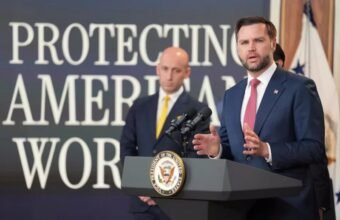
US Vice President JD Vance said the US-Iran talks in Bürgenstock, Switzerland, would not resolve all differences, but would give both sides a chance to address the issues that matter most.
“Today marked the beginning of technical talks that will not solve every disagreement, but will allow us, for the first time in history, to sit together as teams and figure out what matters most to both sides, settle those issues, resolve those issues and work toward a better future,” Vance told reporters.
Vance also said significant progress had already been made in the talks with Iran in Switzerland.
“We have already made great progress in just the last few hours, and I expect that in the coming hours we will make additional progress,” he said.
Calling the meeting “historic,” Vance added: “Never before, outside of Islamabad over the last few months, have Iranian and American leaders met at such a high level.”
The US vice president said President Donald Trump had asked his team “to turn the page, to transform our relationship with the people of Iran and to extend a hand that says to the Iranian people: if your leadership is willing to stop being a driver of regional instability, if they are willing to give up their nuclear ambitions over the long term, then the United States is prepared to fundamentally transform our relationship with that country.”
“That is certainly our goal,” Vance said.
Speaking about the consultations, Vance added: “The question before us now is what we can achieve together. Can we turn the page? Can we change the relationship in the Middle East on a permanent basis? Or will we go back to the old ways? We are not seeking that, but of course it is possible.”
Vance also said that “over the last couple of days, we have seen a lot of progress when it comes to maintaining the ceasefire in Lebanon.”
**17.45
Tehran has signaled just how seriously it takes the high-stakes Swiss peace summit, deploying an ultra-high-profile delegation packed with heavy hitters spanning diplomacy, national security, banking, and energy.
Leading the powerhouse lineup as chief negotiator is Mohammad Bagher Ghalibaf, the current speaker of Iran’s parliament. Ghalibaf boasts deep ties to the nation’s military apparatus, having famously served as a long-time commander of the Revolutionary Guard’s air force before transitions into politics as Iran’s national police chief and a twelve-year stint as the mayor of Tehran.
Flanking him is Foreign Minister Abbas Araghchi, the country’s second-highest-ranking representative at the table. Araghchi brings intense diplomatic gravity to the room, known globally for his intimate alignment with the Supreme Leader’s office. He is joined by Ali Bagheri, a towering figure in Iranian international relations who previously masterminded Iran’s nuclear file negotiations under the late President Ebrahim Raisi.
But it’s the economic muscle of the delegation that reveals Tehran’s immediate goals. With sanctions relief and frozen assets on the line, Iran has put Central Bank Governor Abdolnaser Hemmati and Deputy Oil Minister Hamid Bord—who doubles as the head of the National Iranian Oil Company—directly at the negotiating table. The sheer seniority of the group highlights Iran’s strategy: ensuring that any potential security or maritime breakthroughs are backed immediately by airtight financial and energy agreements.
Institute for the Study of War
** 17:20
U.S. and Iranian negotiators entered the meeting room, officially kicking off high-stakes talks to resolve the conflict in the Middle East.
Members of the American delegation began the session by shaking hands with the Pakistani mediators who helped broker the diplomatic summit. Shortly after, Pakistani Prime Minister Shehbaz Sharif began addressing a packed room of international media, flanked directly by Qatari Prime Minister Sheikh Mohammed bin Abdulrahman bin Jassim Al Thani on his left and U.S. Vice President JD Vance on his right.
The highly anticipated Lucerne Lake Summit follows the recently signed Islamabad Memorandum of Understanding. While top political leadership from all four nations are present to establish the structural groundwork for a permanent peace deal, technical committees are set to remain on-site to hash out deep-seated disagreements regarding nuclear verification, regional ceasefires, and vital maritime shipping routes.
**
15:40
Iranian and U.S. delegations have begun negotiations in Bürgenstock, Switzerland. Mediators from Qatar, Pakistan, and Switzerland are also taking part in the talks.
Prime Minister Muhammad Shehbaz Sharif meeting with Vice President of the United States J.D. Vance on the sidelines of US-Iran technical level talks as a follow -up of Islamabad MoU, being held in Burgenstock, Switzerland, 21 June 2026.#PakistanForPeace pic.twitter.com/vqHHvFhXVR
— Prime Minister’s Office (@PakPMO) June 21, 2026
The U.S. delegation is led by Vice President J.D. Vance and includes Jared Kushner, former President Donald Trump’s son-in-law, as well as Special Envoy Steven Witkoff. The Iranian side is represented by Parliament Speaker Mohammad Bagher Ghalibaf and Foreign Minister Abbas Araghchi.
Before the negotiations began, U.S. Vice President J.D. Vance met with Pakistani Prime Minister Shehbaz Sharif and Pakistan’s Chief of Army Staff Asim Munir in Bürgenstock, according to a statement from the Pakistani Prime Minister’s Office.
** 13:59
Delegations from the United States and Iran, along with mediators from Qatar and Pakistan, have arrived at the venue for technical negotiations in Bürgenstock, according to a statement by Switzerland’s Foreign Ministry.
“The U.S. delegation, led by U.S. Vice President J.D. Vance, the Iranian delegation, headed by Iranian Parliament Speaker Mohammad Bagher Ghalibaf, as well as the mediators — Pakistan and Qatar — have arrived in Bürgenstock,” the ministry said in a post on X.
The head of the Iranian delegation and Speaker of the Iranian Parliament, Mohammad Bagher Ghalibaf, met in Switzerland with Qatari Prime Minister Mohammed bin Abdulrahman Al Thani.
“The agenda of this meeting includes monitoring the implementation of the memorandum’s provisions, particularly Clauses 1 and 11, which concern ending the war on all fronts, especially in Lebanon, and the release of $12 billion in frozen Iranian assets. The discussions also cover Clause 6 of the memorandum, which relates to $300 billion in reconstruction investments,” the agency reported.
** 10:45
The U.S. side aims to turn the preliminary memorandum between Washington and Tehran into a full-fledged agreement within 60 days. Steve Witkoff and Jared Kushner are also taking part in the talks.
The negotiations are taking place against the backdrop of tensions around the Strait of Hormuz and the situation on the Lebanese front.
** 10:30
U.S. Vice President JD Vance has arrived in Switzerland ahead of expected discussions with Iranian officials, as diplomatic efforts continue to ease tensions and explore possible paths toward a broader agreement.
Vance and his wife arrived at Emmen Air Base in Switzerland at 5:59 a.m. (0359 GMT), a vice presidential spokesperson said.