
























The Armenian National Committee of America, or ANCA, has rushed to celebrate what it presents as a major victory on Capitol Hill. On July 22, the House Foreign Affairs Committee voted 44–7 to adopt Amendment No. 143, introduced by Democratic Representative Brad Sherman of California, to H.R. 9087.
The amendment states that, in the view of Congress, Azerbaijan should “immediately and unconditionally release all Armenian prisoners of war and political prisoners.” It was supported by House Foreign Affairs Committee Chairman Brian Mast, a Republican from Florida.
In Baku, this wording is bound to provoke serious objections. Azerbaijan does not regard the individuals concerned as prisoners of war or political prisoners. Its position is that they include people prosecuted or convicted for crimes committed during the occupation of Azerbaijani territories, the years of armed conflict and the activities of the former separatist entity in Karabakh.
Source: azernews
Attempts to portray all of them exclusively as victims of political persecution disregard Azerbaijan’s judicial proceedings and its sovereign right to prosecute alleged crimes committed on its internationally recognised territory.
ANCA nevertheless described the committee vote as an important political breakthrough. Its executive director, Aram Hamparian, went considerably further than the actual language of the amendment. He declared that the release of Armenian detainees, the return of Armenian refugees to Karabakh and the withdrawal of Azerbaijani forces from what ANCA calls Armenian territory should be treated as non-negotiable preconditions for peace.
These additional demands, however, are not contained in the Sherman amendment. They represent ANCA’s political agenda rather than the text approved by the committee.
This distinction matters. The campaign is not merely about the legal status of particular detainees. It is also an attempt to consolidate within the American political establishment a version of the post-conflict reality that is favourable to Armenian advocacy organisations.
That narrative largely excludes the decades-long occupation of Azerbaijani territories, the displacement of hundreds of thousands of Azerbaijanis, the destruction of towns and villages, the continuing danger posed by landmines and the question of accountability for crimes committed against Azerbaijani civilians.
More importantly, the committee’s decision has been presented in a manner that exaggerates its practical significance.
The Sherman amendment is a “sense of Congress” provision. It expresses the political opinion of the committee but does not, by itself, create a legally enforceable requirement. It does not order the White House to impose sanctions, does not compel the Azerbaijani government to take any action and does not overturn decisions made by Azerbaijani courts.
Even more significantly, H.R. 9087 itself failed to advance.
After considering and adopting numerous amendments, the House Foreign Affairs Committee voted 23–28 against reporting the amended bill favourably to the House of Representatives. In other words, the underlying legislation to which the Sherman provision had been attached was rejected by the committee.
ANCA itself acknowledged this inconvenient fact in its public statement, conceding that H.R. 9087 had not cleared the committee in its current form. Nevertheless, the organisation sought to portray the adoption of the amendment as a decisive victory because it had placed committee members formally on record on the issue.
The result is therefore best described as a victory “on credit.” The language was approved, but the legislative vehicle carrying it was not. Unless the provision is revived through another bill, added to a future legislative package or reintroduced separately, it will have no direct legislative effect.
ANCA’s enthusiasm is understandable from a public-relations perspective. The organisation has experienced setbacks in Congress and has invested considerable political and organisational resources in keeping the issue of Armenian detainees on the American agenda. A 44–7 committee vote offers material that can be presented to supporters, donors and Armenian-American voters as evidence that lobbying efforts are producing results.
But a successful lobbying headline is not the same thing as an enacted law.
The author of the amendment, Representative Brad Sherman, is one of the most consistent advocates of Armenian causes in Congress. He serves as a vice chair of the Congressional Armenian Caucus and has long supported stronger US-Armenian relations, increased assistance to Armenia and political pressure on Azerbaijan and Türkiye.
His involvement was therefore entirely predictable. ANCA regularly praises Sherman as one of its most dependable allies on Capitol Hill, while Sherman openly identifies Armenian-related issues as an important part of his foreign-policy work.
Such cooperation is not unusual within the American political system. Lobbying is legal, deeply institutionalised and practised by ethnic, commercial, ideological and foreign-policy groups across Washington.
The problem emerges when the preferences of one lobbying network are presented as though they automatically coincide with the national interests of the United States.
Washington’s policy in the South Caucasus cannot be based solely on the demands of one ethnic constituency. The United States must also consider regional stability, energy security, transportation connectivity, relations with Central Asia, the containment of Iranian influence and the future of the Armenian-Azerbaijani peace process.
From that perspective, a policy built around unilateral pressure on Baku would be strategically questionable. It could undermine relations with a country that occupies an important geographical position and plays a central role in east-west energy and transportation routes.
The amendment also reflects a broader problem in congressional debates concerning Azerbaijan: the selective use of human-rights language.
Those demanding the unconditional release of Armenians held in Baku rarely devote comparable attention to the fate of missing Azerbaijanis, the location of mass graves, the destruction of Azerbaijani cultural and religious sites, the rights of Azerbaijanis expelled from present-day Armenia or the long-term consequences of the occupation.
This selectivity weakens claims that the initiative is based on universal legal or humanitarian principles. Human rights should not be treated as a political instrument that applies only when it serves the interests of a particular lobbying group.
The seven Republican members of the committee who voted against the Sherman amendment were Andy Biggs of Arizona, Tim Burchett of Tennessee, Randy Fine of Florida, Anna Paulina Luna of Florida, Scott Perry of Pennsylvania, Keith Self of Texas and Joe Wilson of South Carolina. Their names are confirmed by the official committee voting record and the House of Representatives member directory.
Their opposition deserves attention not because they necessarily share identical views on Azerbaijan, but because their votes demonstrate that ANCA does not exercise complete control over congressional debate.
Some of these lawmakers have supported efforts to repeal Section 907 of the FREEDOM Support Act, a provision restricting direct US government assistance to Azerbaijan.
Representative Anna Paulina Luna introduced H.R. 6534 in December 2025 to repeal Section 907. The bill was subsequently supported by several Republican co-sponsors, including Randy Fine.
ANCA strongly opposed Luna’s initiative and launched a nationwide campaign urging Armenian Americans to contact lawmakers and resist the repeal of Section 907. The organisation has also publicly criticised individual members of Congress who supported the legislation.
Citizens contacting their elected representatives is a legitimate and routine part of American democracy. Congressional office telephone numbers and email addresses are generally public precisely so that constituents can communicate with lawmakers.
For this reason, describing the publication of official congressional contact information as criminal doxing would be legally questionable unless genuinely private data or threats were involved.
The more relevant issue is political rather than criminal. Organised lobbying campaigns are intended to increase the reputational and electoral cost of opposing a group’s agenda. By mobilising supporters against particular representatives, ANCA seeks to demonstrate that votes against its priorities will provoke a coordinated response.
The July 22 vote shows that such pressure has its limits. Seven lawmakers still voted against the amendment, while the underlying H.R. 9087 ultimately failed to secure committee approval.
The Armenian lobby’s principal miscalculation is its continued reliance on an outdated perception of Azerbaijan. Its strategy often appears to be based on the assumption that Baku can be compelled to abandon its legal and political positions through congressional letters, non-binding resolutions and lobbying campaigns.
That assumption no longer corresponds to regional realities.
Source: APA
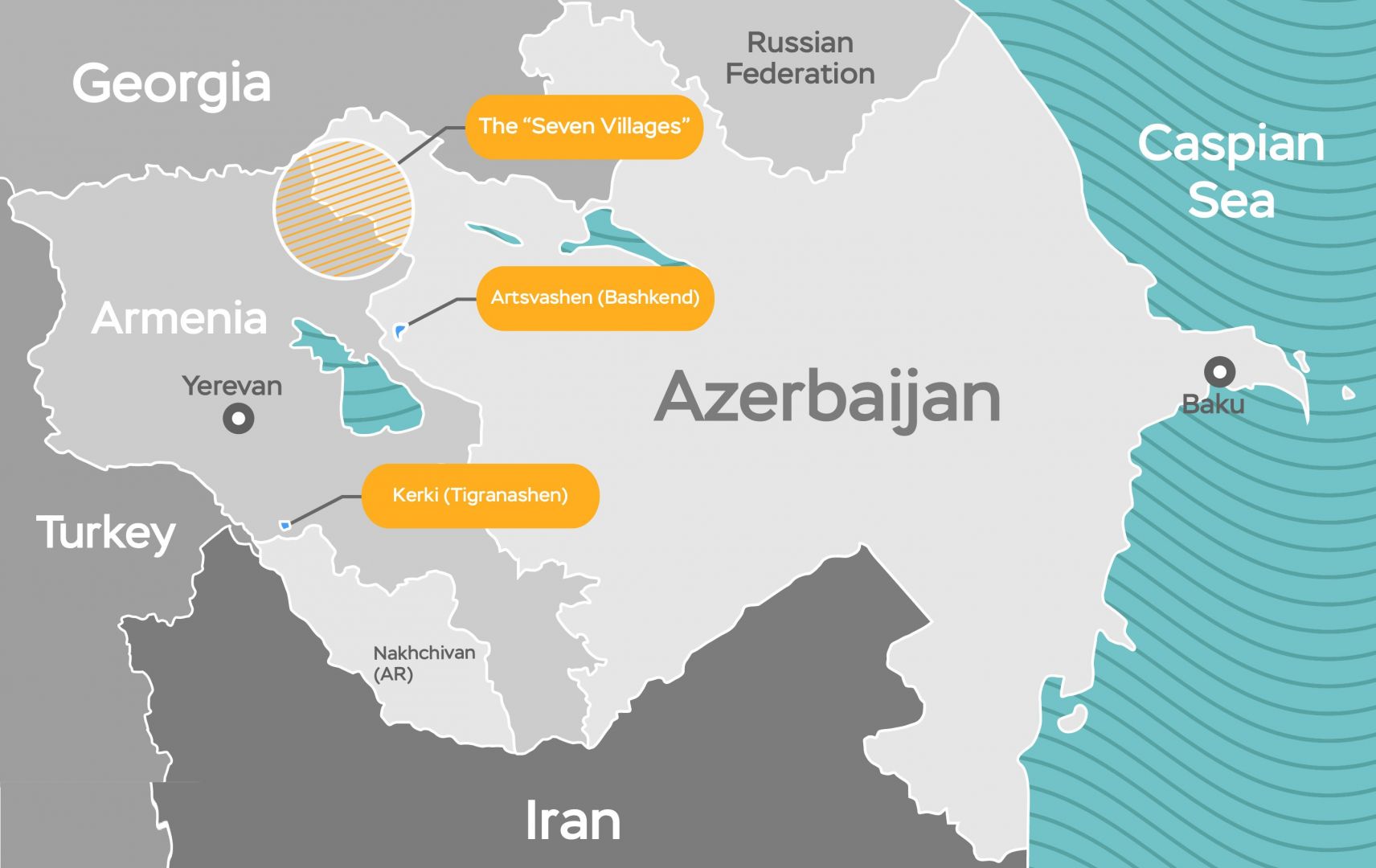
Azerbaijan has restored control over its internationally recognised territory and pursues an increasingly independent foreign policy. Baku remains interested in constructive relations with the United States, the European Union and other major international actors, but it has repeatedly made clear that it will not accept relations based on ultimatums.
No resolution adopted by a foreign parliamentary committee can automatically invalidate the decisions of an Azerbaijani court. Questions surrounding the detainees must be addressed through legal procedures, negotiations or sovereign political decisions—not through the assumption that a lobbying organisation in Washington can dictate the outcome.
This does not exempt Azerbaijan from the obligation to ensure transparent judicial proceedings consistent with its laws and international commitments. On the contrary, credible evidence, access to legal representation and procedurally sound trials are the strongest response to politically motivated accusations.
But assessments of individual cases should be based on facts and legal standards, not on the political sympathies of particular members of Congress.
ANCA’s celebration is therefore premature.
The committee adopted a non-binding amendment, but rejected the bill to which it had been attached. The provision does not impose sanctions, does not create a mandatory course of action for the US administration and does not compel Azerbaijan to release anyone.
What happened on Capitol Hill was a political signal—not a legislative breakthrough.
Armenian advocacy organisations may continue spending money and political capital on lobbying, media campaigns and pressure on lawmakers. Yet such activities cannot reverse the new balance of power in the South Caucasus or place the preferences of an ethnic lobbying network above Azerbaijan’s sovereignty.
Azerbaijan has repeatedly expressed its readiness for peace. But a durable settlement cannot be built by rewriting the history of the conflict, ignoring crimes committed against Azerbaijanis or demanding that decisions made in Washington take precedence over Azerbaijani law.
For now, ANCA has little reason to declare victory. The 44–7 vote was merely one episode in a much broader lobbying campaign—and its practical impact is far more limited than the celebratory headlines suggest.