













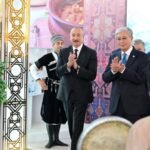



The deals were announced on Thursday during the Sixth Belt and Road China–Malaysia Business Dialogue, held in Yinchuan, the capital of Ningxia Hui Autonomous Region in northwest China, News.Az reports, citing CNBC.
***
Agreements span agriculture, trade and investment
In total, 26 projects were agreed, covering sectors including economic and trade investment, as well as modern agriculture.
Officials said the agreements reflect an expansion of bilateral cooperation, as both countries seek to strengthen partnerships under the Belt and Road Initiative.
More than 200 government officials and business representatives attended the forum, discussing collaboration across a wide range of sectors, including science and technology, culture, and tourism.
Trade relationship continues to evolve
China has remained Malaysia’s largest trading partner for several consecutive years, with ties increasingly shifting beyond traditional commodity trade towards integrated supply chains and industrial cooperation.
Speaking at the event, Ma Hui, deputy head of the International Department of the Communist Party of China Central Committee, described the dialogue as a key platform for strengthening both political and economic engagement.
He urged both sides to take advantage of current opportunities to deepen cooperation and consolidate long term ties.
Focus on innovation and future industries
Chang Lih Kang, Malaysia’s Minister of Science, Technology and Innovation, said the dialogue plays an important role in providing stability amid global economic uncertainty.
He highlighted opportunities for joint ventures in areas such as energy transition and artificial intelligence, noting that Malaysia’s emerging AI academic sector has already benefited from collaboration with Chinese institutions.
Ningxia’s growing international role
The event also showcased Ningxia’s increasing prominence as an inland open economy hub.
Malaysia has become the region’s largest export market for agricultural products, with strong demand for items such as cool climate vegetables, goji berries, and frozen potatoes.
Tourism and cultural exchanges on the rise
Cultural and people to people exchanges are also accelerating. In 2025, the number of Malaysian tourists staying overnight in Ningxia rose by more than 200 percent compared with the previous year, making Malaysia the region’s leading source of international visitors.
The dialogue was co hosted by the China Economic Cooperation Center, the Malaysia China Business Council, and Ningxia’s regional foreign affairs office, highlighting the institutional support behind expanding bilateral ties.
Analysts say the latest agreements signal continued momentum in China–Malaysia relations, with both sides seeking to deepen economic integration while expanding cooperation into new and emerging sectors.