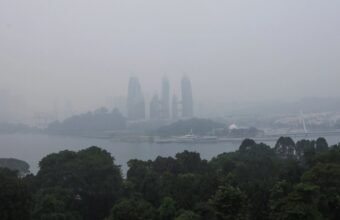




























Singapore’s Minister for Sustainability and the Environment, Grace Fu, announced on Friday that the government would issue preventive measure notices to seven companies in Indonesia identified as responsible for fires contributing to the ongoing haze.
Under these notices, the companies will be required to take steps to control fires on land they own or occupy, including deploying firefighting personnel to extinguish existing fires and prevent them from spreading.
Fu also warned that Singapore’s air quality could deteriorate further, potentially reaching hazardous levels.
Associate Professor Jolene Lin of the National University of Singapore (NUS) explained that the Transboundary Haze Pollution Act, which came into force in 2014, allows Singaporean authorities to take action against companies responsible for causing or contributing to transboundary air pollution.
The legislation empowers authorities to request documents and information from relevant parties and issue notices requiring preventive measures.
It also provides legal avenues for individuals and businesses suffering significant harm from haze pollution to pursue claims against companies allegedly responsible.
However, Lin, who also serves as director of the Asia-Pacific Centre for Environmental Law, cautioned that pursuing enforcement action involves more than legal considerations.
She recalled that Singapore’s attempts to apply the legislation in 2015 generated objections in Indonesia, where some critics argued that enforcing Singaporean laws against activities conducted on Indonesian territory infringed upon national sovereignty.
According to Lin, international law recognizes a country’s right to manage its natural resources while also requiring it to prevent activities within its territory from causing environmental harm beyond its borders.
She argued that Singapore’s exposure to pollution originating from Indonesian forest fires provides a legal basis for measures aimed at addressing the resulting damage.
Nevertheless, she emphasized that exercising those legal powers could affect diplomatic relations between the two countries.
Michelle Lim, an associate professor of law at Singapore Management University, also highlighted the political sensitivities surrounding potential legal action against companies operating in Indonesia.
Lim said that while Singapore possesses legal jurisdiction under its domestic legislation, the way enforcement measures are perceived by Indonesian authorities remains an important consideration.
She noted that legal proceedings involving businesses based in the territory of a close and influential neighboring country could carry wider diplomatic implications.
The debate comes as Singapore continues to experience haze pollution linked to fires in Indonesia, with authorities taking preventive steps while monitoring the potential for further deterioration in air quality.
The planned notices to seven Indonesian companies represent an effort by Singapore to address the sources of the pollution, although any subsequent enforcement action may require careful consideration of both legal and diplomatic factors.