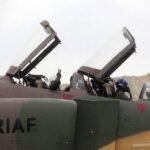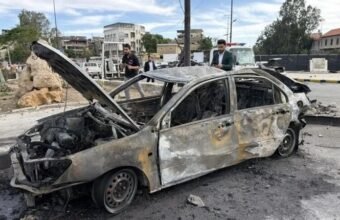


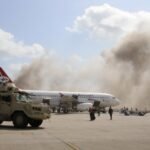














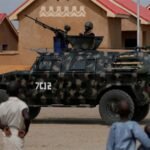

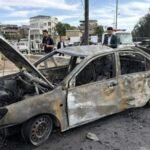


A Syrian official said the air base was attacked eight times. The strikes reportedly hit the runway and an inactive structure located inside a hangar. No casualties or injuries were immediately reported.
***
The extent of the material damage has not been fully disclosed. It is also unclear whether the attacks left the runway unusable or were intended to prevent the base from being restored for future military operations.
US Ambassador to Ankara Tom Barrack, who also serves as Washington’s special envoy for Syria and Iraq, said the intelligence behind the strike was inaccurate. According to him, Israel had received information claiming that Türkiye could be transferring military assets to the facility and shared that assessment with Washington.
Barrack said American intelligence agencies examined the allegation but found no evidence supporting it. He also stated that neither the United States nor Türkiye had been informed in advance that Israel planned to attack the air base.
Israel has not provided a detailed public explanation of the intelligence used to authorise the operation or addressed Barrack’s assertion that the underlying claim was false.
The immediate incident caused no reported casualties, but its diplomatic implications could be considerable. The strike involved Israel, Syria and allegations about Türkiye, while Washington was drawn into the dispute because Israeli officials had apparently shared the original intelligence assessment with the United States.
What did Tom Barrack say about the intelligence behind the strike?
Barrack said Israel had received intelligence indicating that Türkiye might be moving military assets to Abu al-Duhur Military Air Base. Israeli officials then shared that information with Washington, prompting the United States to examine the allegation through its own intelligence agencies.
“We consulted our intelligence agencies, and the answer we received was that this claim was not true,” Barrack said in a social media post.
His statement directly challenges the factual basis publicly associated with the strike. If the US assessment is correct, Türkiye was not attempting to deploy forces or establish military installations at the base when Israel carried out the attack.
Barrack did not identify where the original intelligence came from, when Israel received it or what evidence was presented to Washington. He also said he did not know why Israel ultimately decided to strike the facility.
This creates an important distinction. Barrack rejected the claim about a Turkish deployment, but he did not establish that the disputed intelligence was the only reason for Israel’s operation. Israel could argue that it acted on additional information that has not been disclosed.
The ambassador also did not say whether Washington informed Israel of its assessment before the attack. That timeline would help determine whether Israeli decision-makers acted before receiving the US response or proceeded despite being told that the allegation was unsupported.
Barrack’s statement therefore clarifies Washington’s assessment without providing a complete explanation of the Israeli decision. It raises questions about intelligence verification, communication among allies and whether an unconfirmed report contributed to an unnecessary military strike on Syrian territory.
Could internal Israeli miscommunication have caused the attack?
Barrack suggested that there may have been “a miscommunication” between the Israeli military, the Mossad intelligence agency and Prime Minister Benjamin Netanyahu’s office. He did not provide evidence explaining what information each institution received or how their assessments differed.
In a military decision-making process, intelligence may pass through several agencies before reaching political leaders. Analysts assess reliability, military officials evaluate operational risks and senior decision-makers decide whether action is justified. A misunderstanding or incomplete transmission at any stage can affect the final decision.
The term “miscommunication” could describe several possibilities. Intelligence may have been treated as confirmed when it remained preliminary, an assessment may have lost important qualifications as it moved between institutions, or officials may have interpreted the same information differently.
However, Barrack did not say that such a failure had been proven. His wording indicated a possible explanation rather than a confirmed finding. Israel has not announced an internal investigation or acknowledged that its institutions communicated incorrectly.
Netanyahu and his office had previously claimed that Turkish soldiers were attempting to establish a presence at the base and deploy military installations farther south. Those assertions appear inconsistent with the US intelligence assessment described by Barrack.
Determining whether miscommunication occurred would require access to the original intelligence report, internal assessments and the timeline of decisions preceding the strike. It would also be necessary to establish what Israeli officials knew when the attack was authorised.
Until that information is available, the cause of the apparent intelligence failure remains uncertain. Barrack’s remarks highlight a possible institutional problem but do not identify which Israeli body, if any, provided inaccurate information or failed to verify it properly.
Why would a possible Turkish military presence concern Israel?
Türkiye has significant security interests in Syria, while Israel closely monitors any change in the military balance across the country. The possibility of Turkish forces using or restoring a Syrian air base could therefore attract attention from Israeli defence and intelligence officials.
A functioning military air base can support aircraft, drones, logistics, surveillance and the movement of personnel or equipment. Even if Türkiye’s purpose were defensive or connected to stabilisation, Israel might seek information about the type of systems being deployed and their potential effect on Israeli operations.
The reported concern was not limited to Turkish personnel being present at Abu al-Duhur. Netanyahu and his office had claimed that Türkiye was attempting to establish military installations farther south. Such a development could create new areas where Israeli and Turkish forces operate in proximity, increasing the risk of confrontation or accidental escalation.
Barrack’s account, however, indicates that Washington found no evidence that Türkiye was moving military assets to the base. The strategic sensitivity of a possible deployment does not establish that one was actually taking place.
The episode demonstrates how expectations about future military positioning can influence decisions before infrastructure becomes operational. Israel may have intended to prevent the base from being used rather than respond to an already functioning Turkish facility.
Barrack praised the Turkish military as “strong and brave,” describing it as well-equipped and highly capable. His comments may have been intended to emphasise that allegations involving Turkish forces should be treated seriously and verified carefully.
If the intelligence was false, the strike may have created the very tensions that preventive action was supposed to avoid, complicating relations among Israel, Türkiye, Syria and the United States.
Why does the lack of advance notification matter?
Barrack said neither Washington nor Ankara was informed before Israel attacked the Abu al-Duhur air base. The lack of notification is important because both countries have major interests in Syria, and the strike was reportedly connected to allegations involving Turkish forces.
Advance communication can help prevent misunderstandings and reduce the risk that one country’s personnel are harmed by another country’s military operation. If Israel genuinely believed Turkish assets were present, notifying Ankara could have clarified the situation or allowed Türkiye to confirm that it had no forces at the site.
Communication with Washington could also have been relevant because Israel had reportedly shared the intelligence with the United States. If US agencies were already evaluating the claim, advance notice could have allowed their findings to be considered before military action.
Countries may avoid notifying partners when they believe secrecy is essential to operational success. Warning another government can increase the risk of information leaks or allow a target to move equipment. However, that calculation becomes more difficult when the suspected presence belongs to an allied or partner state.
The absence of notice also complicates crisis management after the strike. Türkiye may interpret the operation as a warning directed at its broader role in Syria, while Washington may question why Israel acted without waiting for intelligence coordination.
No Turkish casualties were reported, and Barrack said there was no evidence of a Turkish deployment at the base. The immediate risk of direct confrontation therefore remained limited.
Nevertheless, the incident demonstrates the importance of deconfliction mechanisms. As multiple countries conduct military or security operations in Syria, unclear communication can turn unverified intelligence into strikes with wider diplomatic consequences.
How could the incident affect Israel-Türkiye relations?
The strike could deepen mistrust between Israel and Türkiye because Israeli officials publicly associated the air base with an alleged Turkish military deployment. Washington’s subsequent assessment that the claim was untrue may increase Ankara’s concerns about Israel’s intentions in Syria.
Türkiye may view the attack as an attempt to restrict its future security role even if no Turkish forces were present at Abu al-Duhur. Israel may argue that it acted to prevent military developments it considered potentially threatening.
The dispute is especially sensitive because both countries possess capable armed forces and have strategic interests in Syria. If they operate in nearby areas without reliable communication, a future strike could risk casualties and create pressure for retaliation.
Barrack’s position places the United States between two important partners. Washington may need to reassure Türkiye that it does not support attacks based on unsupported claims while maintaining its security relationship with Israel.
The ambassador’s praise for the Turkish military and his rejection of the intelligence allegation could be interpreted as an effort to limit diplomatic damage. At the same time, his public suggestion of miscommunication within Israel may create discomfort in relations between Washington and the Israeli government.
The incident could encourage Türkiye to demand clearer guarantees about Israeli operations near areas where Turkish personnel may operate. Israel, in turn, may seek greater transparency concerning Türkiye’s military plans in Syria.
Avoiding escalation will require communication before future operations rather than only explanations after strikes occur. A mechanism allowing the parties to verify reports of military movements could reduce the risk of action based on inaccurate information.
The longer-term effect will depend on whether Israel acknowledges an intelligence failure and whether similar incidents occur.
What key questions remain unanswered?
The most important unanswered question is why Israel authorised the strike if US intelligence agencies found no evidence of a Turkish deployment. Barrack said he did not know Israel’s reason, leaving open the possibility that other considerations influenced the operation.
The timeline is also unclear. It has not been established when Israel shared its information with Washington, when US agencies completed their assessment and whether Israel received that conclusion before the airstrike.
Israel has not disclosed the source of the original intelligence or explained why it considered the information credible. It is also unknown whether surveillance showed any activity at Abu al-Duhur or whether the assessment was based primarily on reports about Türkiye’s broader plans in Syria.
Another question concerns the damage. A Syrian official said the base was attacked eight times and that the runway and an inactive structure in a hangar were targeted. No independent assessment has established how severely the facility was damaged or how long repairs would take.
Neither Israel nor Türkiye has provided a complete public response to Barrack’s account. Their statements will be important in determining whether the incident develops into a larger diplomatic dispute.
There is also no confirmation that Israel has opened an internal review into possible miscommunication among the military, Mossad and Netanyahu’s office. Such an inquiry could determine whether the intelligence was inaccurate, misunderstood or used as justification for a decision made on other grounds.
For now, the confirmed positions remain sharply different. Israeli officials had alleged a Turkish military plan, while Barrack says US intelligence found the claim untrue. Resolving that contradiction is essential to understanding why the Syrian base was attacked.