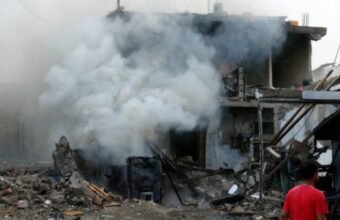



























According to the head of the Zaporizhzhia Regional Military Administration, Ivan Fedorov, the attack prompted an immediate emergency response as rescuers feared that residents could be trapped beneath the rubble following the explosion. Firefighters, medical teams and specialized search-and-rescue units were dispatched to the site to assess the damage, evacuate residents and search for possible survivors, News.Az reports.
Table Of Content
***
Initial reports suggested that several people might have been buried under the collapsed sections of the building. However, after emergency crews completed their preliminary search, authorities said those fears had not been confirmed. Officials later reported that 18 people required medical treatment for injuries sustained during the strike. The attack caused extensive structural damage to the residential building, leaving many apartments uninhabitable and forcing residents to evacuate.
The latest strike is part of a continuing series of Russian attacks targeting civilian areas in Zaporizhzhia. Local authorities have repeatedly warned that residential neighborhoods remain under constant threat from missiles, guided aerial bombs and drones. The attack also illustrates the continuing risks faced by civilians living in cities located relatively close to the front line, where Russian forces possess the capability to launch frequent long-range strikes.
Why is Zaporizhzhia being targeted?
Zaporizhzhia occupies a strategically important position in southeastern Ukraine and has become one of the country’s most frequently targeted regional centers since Russia launched its full-scale invasion in February 2022. Although the city itself remains under Ukrainian control, it lies relatively close to the active front line, making it vulnerable to regular missile, drone and guided bomb attacks.
The broader Zaporizhzhia region is partially occupied by Russian forces and has significant military, logistical and industrial importance. Russia has repeatedly targeted the city with the stated objective of disrupting Ukrainian military logistics, infrastructure and industrial capacity. However, many attacks have struck residential neighborhoods, commercial facilities and other civilian infrastructure, resulting in casualties among the local population.
Military analysts say Russian forces increasingly use long-range precision-guided weapons against cities located behind the front line in an effort to weaken Ukraine’s economy, disrupt transportation and create psychological pressure on civilians. These attacks often occur without warning, forcing residents to spend extended periods in shelters during repeated air raid alerts.
The city’s strategic location also makes it an important transportation hub connecting central and southern Ukraine. Damage to infrastructure in Zaporizhzhia can affect military logistics, humanitarian operations and economic activity across a wider region.
What weapons is Russia using in these attacks?
In recent months Russia has increasingly relied on a combination of guided aerial bombs, attack drones, ballistic missiles and cruise missiles to strike targets across Ukraine. In the Zaporizhzhia region, guided bombs have become particularly common because they can be launched from aircraft operating well behind Russian-controlled territory, reducing risks to Russian pilots while allowing strikes against cities near the front line.
Guided aerial bombs are conventional bombs fitted with navigation and guidance systems that significantly improve their accuracy and range. They carry large explosive warheads capable of causing severe structural damage to apartment buildings, industrial facilities and other infrastructure. Even when they strike near rather than directly on a building, the blast wave can destroy entire sections of residential blocks.
Russia has also expanded its use of drones, particularly Shahed-type loitering munitions, to overwhelm Ukrainian air defenses and attack infrastructure. Drone attacks are often carried out simultaneously with missile or bomb strikes to complicate defensive responses.
Military experts note that combining different types of aerial weapons enables Russia to maintain sustained pressure on Ukrainian cities while forcing Ukrainian air defense systems to intercept multiple threats arriving from different directions. This evolving strategy has contributed to increasingly frequent attacks against civilian areas throughout Ukraine.
Has Zaporizhzhia experienced similar attacks recently?
Yes. The latest strike forms part of a series of Russian attacks against Zaporizhzhia over recent days. On July 19, Russian guided aerial bombs struck another apartment building in the city, destroying two floors of a five-story residential block. That attack killed two civilians and injured at least ten others while causing extensive destruction to nearby homes.
Only two days later, on July 21, Russian forces again targeted residential neighborhoods with guided bombs, resulting in additional civilian casualties. The repeated attacks demonstrated that civilian districts continue to face significant risks despite the absence of major military installations in many of the affected areas.
On July 22, another Russian attack targeted an industrial facility in Zaporizhzhia. A drone strike ignited a large fire at a food processing plant, damaging infrastructure and injuring several people. Emergency crews spent hours extinguishing the blaze while authorities assessed the extent of the destruction.
The succession of attacks over only a few days illustrates an apparent intensification of Russia’s aerial campaign against the region. Ukrainian officials argue that the pattern demonstrates deliberate pressure on civilian infrastructure rather than isolated incidents, while international organizations continue monitoring reports of damage to residential areas and public facilities.
Why are residential buildings increasingly being hit?
Ukrainian authorities argue that Russia has increasingly expanded its attacks beyond military targets to include civilian infrastructure, residential neighborhoods and commercial facilities. Moscow maintains that it targets military objectives, although many strikes have resulted in significant civilian casualties and widespread destruction of apartment buildings, schools, hospitals and energy infrastructure.
Military analysts note that modern urban warfare makes it difficult to completely separate military and civilian infrastructure, particularly in densely populated cities. However, repeated strikes on residential buildings have prompted widespread international concern regarding compliance with international humanitarian law and the protection of civilians during armed conflict.
The use of powerful guided bombs against urban areas significantly increases the risk of civilian casualties because of their large explosive payloads. Even when aimed at nearby objectives, the resulting blast waves can destroy surrounding buildings, shatter windows hundreds of meters away and cause structural collapses.
Human rights organizations have repeatedly called for independent investigations into attacks that result in civilian casualties, emphasizing the importance of distinguishing between military objectives and protected civilian objects under international law.
What is the humanitarian impact of these attacks?
Repeated airstrikes have placed enormous pressure on civilians living in Zaporizhzhia and across Ukraine. Beyond immediate casualties, attacks on residential neighborhoods leave thousands of people without safe housing, electricity, water and other essential services. Families whose homes are damaged often require temporary shelter while emergency repairs are carried out.
The psychological impact has also been significant. Residents live under frequent air raid alerts, often spending hours in shelters during the night. Children, elderly people and individuals with disabilities are particularly vulnerable to the long-term effects of repeated bombardment, displacement and uncertainty.
Emergency responders face increasing challenges as attacks become more frequent. Rescue workers must rapidly search damaged buildings for survivors while also remaining alert to the possibility of secondary strikes. Medical facilities continue treating victims of blast injuries, burns and trauma resulting from repeated attacks.
Humanitarian organizations operating in the region continue providing emergency assistance, including temporary accommodation, food, medical supplies and psychological support. However, continued attacks complicate relief efforts and increase the number of civilians requiring assistance.
What does the latest attack indicate about the war?
The latest strike reflects Russia’s continuing aerial campaign against Ukrainian cities far beyond the immediate front line. Since the beginning of the full-scale invasion, aerial attacks have become a central feature of the conflict, with Russia employing missiles, drones and guided bombs to target infrastructure across Ukraine.
Military analysts believe these attacks are intended to reduce Ukraine’s military capabilities while also placing sustained pressure on the civilian population and critical infrastructure. At the same time, Ukraine has strengthened its air defense network with support from Western partners, intercepting many incoming missiles and drones. Nevertheless, not every attack can be prevented, particularly when multiple weapons are launched simultaneously.
The continued targeting of cities such as Zaporizhzhia demonstrates that civilian populations remain directly exposed to the consequences of the war, even in areas not experiencing active ground combat. As long as hostilities continue, experts expect aerial attacks on Ukrainian urban centers to remain a major feature of the conflict, underscoring the ongoing humanitarian and security challenges facing the country.