


























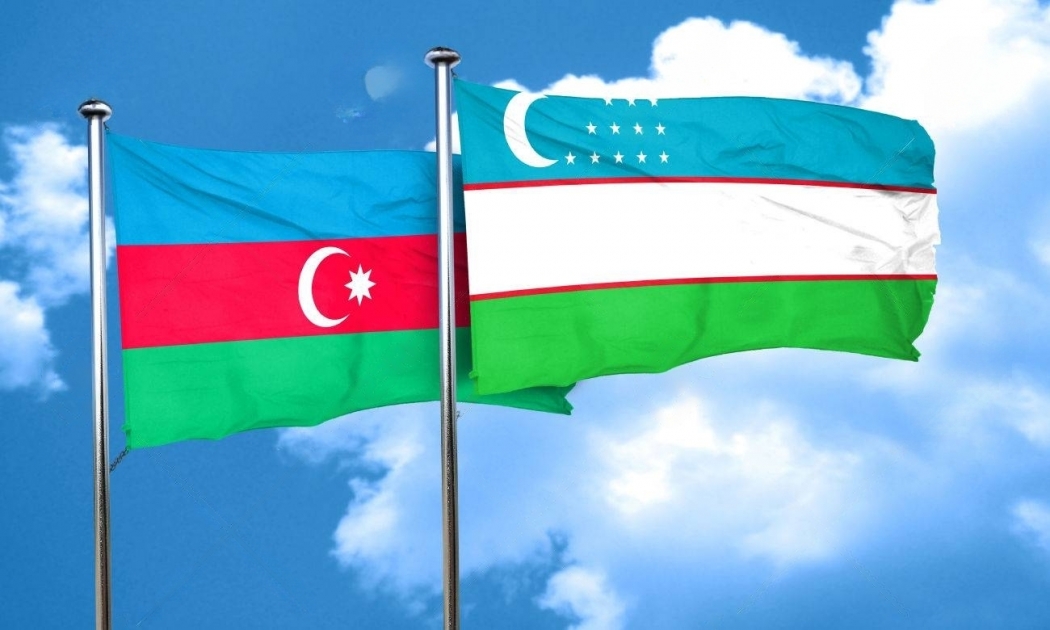
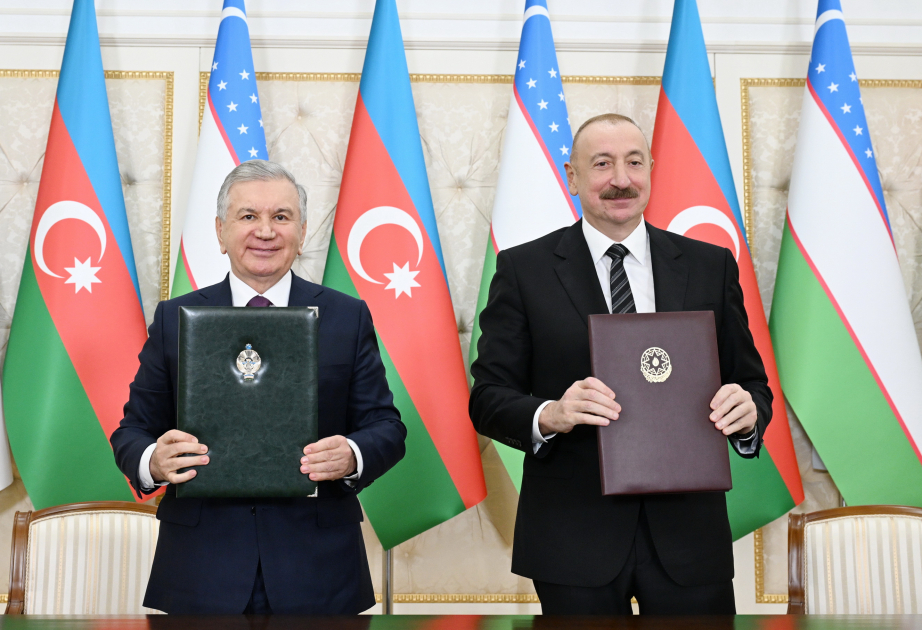
As President Ilham Aliyev noted in his interview, relations between Azerbaijan and Uzbekistan have reached their highest level, that of allied relations. The signing of the Treaty on Allied Relations in 2024, together with the Declaration on Further Strengthening of Strategic Partnership and the establishment of the Supreme Interstate Council, has created a stronger institutional and political foundation for long term cooperation between the two countries. The fact that the two presidents have maintained exceptionally intensive contact and that bilateral cooperation now extends across politics, investment, industry, transport, logistics, energy, agriculture, education and culture demonstrates that the relationship is becoming more comprehensive.
In my view, the most important feature of this alliance is the way it combines political trust with practical interests. Azerbaijan and Uzbekistan have complementary geographical positions. Uzbekistan is one of the key economic and demographic centers of Central Asia, while Azerbaijan is positioned at the intersection of the Caspian Sea, the South Caucasus and the routes leading toward Türkiye and Europe. It gives even more significance to the bilateral relationship between Uzbekistan and Azerbaijan as it connects two regions that historically have been closely linked but that were separated institutionally and physically for much of the modern period.
Trade is also one of the important aspects of the bilateral relationship. According to President Aliyev, bilateral trade reached 795 million US dollars in 2025, more than three times the previous year’s level, while the Azerbaijan Uzbekistan Investment Company has a capital of 500 million US dollars. These figures indicate that political trust is turning into economic interdependence.
I would therefore describe Azerbaijan and Uzbekistan as a potentially important model for the broader Turkic world. Their experience shows that common historical and cultural identity can be transformed into practical cooperation in investment, manufacturing, transport, energy, education and technology. This is even more significant because the Organization of Turkic States includes countries with different economic structures and geographical positions. The Baku-Tashkent relationship demonstrates how countries with complementary advantages can build a form of cooperation that combines cultural affinity with economic interests.
For the wider region, the significance is that this is potentially becoming an alliance between a Central Asian hub and a Caspian and South Caucasian hub. I believe that Baku and Tashkent can become two important pillars of a wider regional architecture connecting Central Asia with the Caucasus, Türkiye and European markets. This is why I see the alliance as much more than a bilateral relationship. It can become one of the building blocks of a more interconnected Eurasian region.
Source: azertag
Uzbekistan is a geographically landlocked country. However, it is one of the main economic hubs of the region, with a population of nearly 40 million. In recent years, Uzbekistan has been working on various logistics projects, including the Trans-Afghan Railway to access Pakistani ports, the China–Kyrgyzstan–Uzbekistan railway, and the Middle Corridor.
President Aliyev’s reference to the China-Kyrgyzstan-Uzbekistan railway and its potential integration with the Middle Corridor is therefore significant. The interview presents these routes as parts of a broader East West network connecting China and Central Asia through the Caspian Sea and Azerbaijan toward the South Caucasus, Türkiye and Europe.
For Uzbekistan, this could create several strategic advantages. Firstly, it would diversify the country’s export and import routes. Uzbekistan would have greater ability to reach European markets without depending excessively on any single traditional transit direction. Diversification is essential because it could offer more resilience, predictable routes in case of geopolitical or logistical disruptions.
Secondly, the development of these corridors could strengthen Uzbekistan’s position as a logistics and production center in Central Asia. If transport infrastructure becomes more efficient, Uzbekistan does not have to be limited by exporting only raw materials or domestic goods but also participate in regional value chains, where components move between China, Central Asia, the Caucasus, Türkiye and Europe. This is where connectivity becomes an industrial policy issue rather than simply a transportation issue.
There are already signs that this is becoming commercially relevant. According to Uzbekistan’s diplomatic representation in Belgium, Uzbek cargo transported through the Middle Corridor reached approximately 1.2 million tons in 2025, while the share of cargo moving through this route toward European Union countries increased from 12 percent in 2021 to 28 percent by the end of 2025.
I believe the transition from C5 to C6 is one of the most significant recent developments in the regional architecture surrounding Central Asia. President Aliyev himself described Azerbaijan’s full participation as evidence of the growing strategic importance of the relationship between Azerbaijan and Central Asia and emphasized that it broadens the scope of regional dialogue and cooperation.
The significance of C6 is that it challenges the traditional understanding of Central Asia as a purely continental space consisting of five states. Increasingly, the region’s economic future is connected to the Caspian Sea and the South Caucasus. Azerbaijan’s participation therefore gives the Central Asian format a stronger interregional dimension.
For many years, one of the central challenges of Central Asian economies has been geographical. The region has enormous economic potential, but its distance from major maritime outlets has increased the cost and complexity of international trade. Azerbaijan provides a natural bridge toward the Caspian, South Caucasus, Türkiye and European markets. In this sense, C6 can help turn Central Asia from a landlocked region into a more effectively land linked region.
The International Institute for Central Asia has similarly described Azerbaijan’s participation as a qualitative change in the regional architecture, arguing that Central Asia and Azerbaijan are increasingly forming a connected geopolitical and geo economic space.
For Uzbekistan, this opens opportunities in several directions. The first is transport. C6 can provide a stronger political framework for coordinating infrastructure and reducing fragmentation along routes connecting Central Asia with the Caspian and beyond.
Source: azertag
The second is trade and investment. Greater regional connectivity can encourage companies to think beyond individual national markets and develop regional supply chains. Uzbekistan’s industrial and agricultural production can potentially reach wider markets, while Azerbaijani companies can use Uzbekistan as a platform for deeper engagement with Central Asia.
The third is energy. Azerbaijan and Central Asian states have complementary interests in energy connectivity, including renewable energy. The interview itself highlights the Azerbaijan Central Asia Green Energy Corridor involving Azerbaijan, Kazakhstan and Uzbekistan.
The fourth is political coordination. C6 gives Azerbaijan and the Central Asian states another institutional space in which they can discuss common interests, while preserving the sovereignty and independent foreign policies of each participant.
Achievements in the field of trade, investment, culture, tourism and other fields as mentioned during the interview prove Baku and Tashkent can become important engines of practical cooperation within the Organization of Turkic States.
In 2025, bilateral trade reached 795 million US dollars. More than 130 companies with Uzbek investment are operating in Azerbaijan, while Azerbaijani companies are implementing major projects in Uzbekistan. Tourism is also growing, with 62,000 Uzbek citizens visiting Azerbaijan in 2025. Cultural cooperation includes the Uzbekistan Park in Baku, the naming of the National Pedagogical University of Uzbekistan after Nizami Ganjavi, the Days of Culture of both countries, cooperation between their media and NGOs, and an expanding network of twin cities.
I believe this experience can serve as a practical model for other Turkic countries. If similar cooperation is developed across the OTS, particularly in trade, investment, transport, energy, education and culture, the organization can move from shared identity toward deeper practical integration. Azerbaijan and Uzbekistan are showing that common history and cultural ties can be translated into concrete economic and institutional cooperation, creating a stronger and more connected Turkic world.
Connectivity is clearly one of the areas with the greatest potential. As President Aliyev noted in the interview, Azerbaijan and Uzbekistan occupy complementary positions along important East-West routes. Further development of the Middle Corridor and related infrastructure could strengthen trade between our countries while also creating new opportunities for logistics, regional supply chains and access to wider markets.
Investment is another major area of potential. Central Asia is a market of over 80 million people, and combining Uzbekistan’s large domestic and regional market with Azerbaijan’s access to the Caspian, the South Caucasus and European markets creates significant opportunities for joint investment and production. The existing Azerbaijan-Uzbekistan Investment Company provides an important foundation for taking this cooperation further.
I would also highlight education and technology cooperation. As the world is changing rapidly and economies become increasingly digitalized, cooperation in artificial intelligence, digital technologies, research and innovation can help both countries develop the skills and technologies needed for the next stage of economic growth.
Finally, tourism has considerable untapped potential. Uzbekistan offers some of the most important historic cities of the Silk Road, including Samarkand, Bukhara and Khiva, while Azerbaijan offers its own rich heritage and diverse natural landscapes. With growing connectivity and direct air links between the two countries, tourism can become another important bridge between our societies and economies.